Introduction
I have been a volunteer with the Illinois Library Association’s Public Policy Committee since 2023. This committee provides the association’s focus on legislative matters for all libraries in Illinois. During my time as committee chair in 2025, our committee introduced legislation to help libraries with the high costs of eBooks and e-content.
How did we arrive at this moment?
eBooks & e-Audiobooks are not free for libraries
Typically, this is a surprise when explained to the public. Libraries are not the creators or stewards of eBooks within their public programs. Libraries do not control the contract terms of the of the eBook platforms in the areas of lending and price. The public is mostly familiar with the eBook app Libby, but they know little about the strict controls in place dictating price and lending.
In the lead up to my time on the Public Policy Committee, my discussions with public library directors on trends within their services began noting the huge increase in costs for eBooks from a collection budget perspective, with e-content platforms taking up 50% of their collection budget.
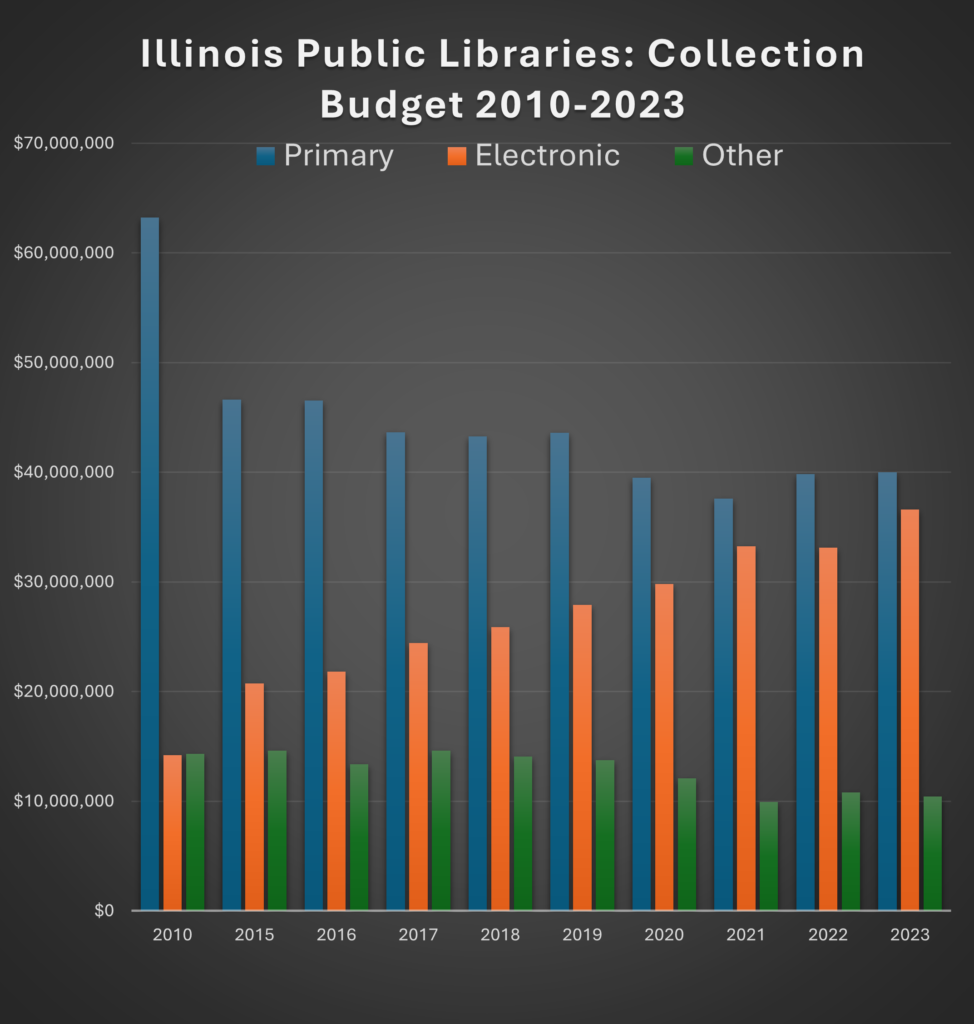
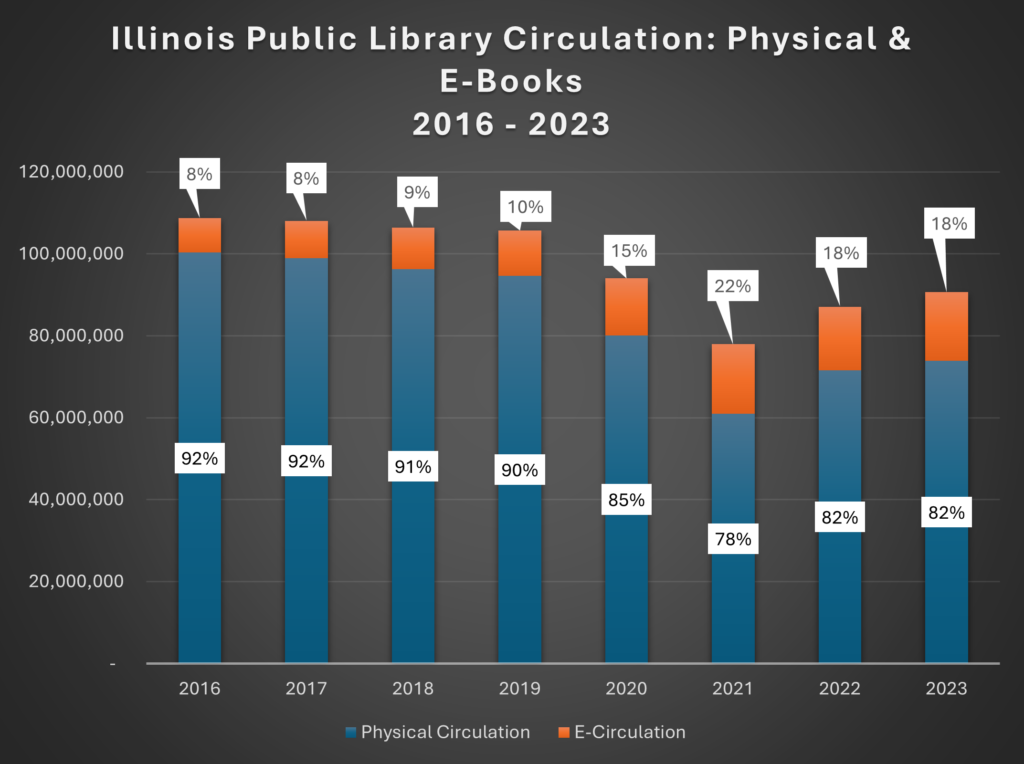
I researched this further within Institute for Museum and Library Services public library data, and found that overall that eBook circulation for libraries was 20% of the total circulation, with the 80% circulation being the tradition physical collections. What was causing half of libraries collection budget going to only 20% of its total circulation?
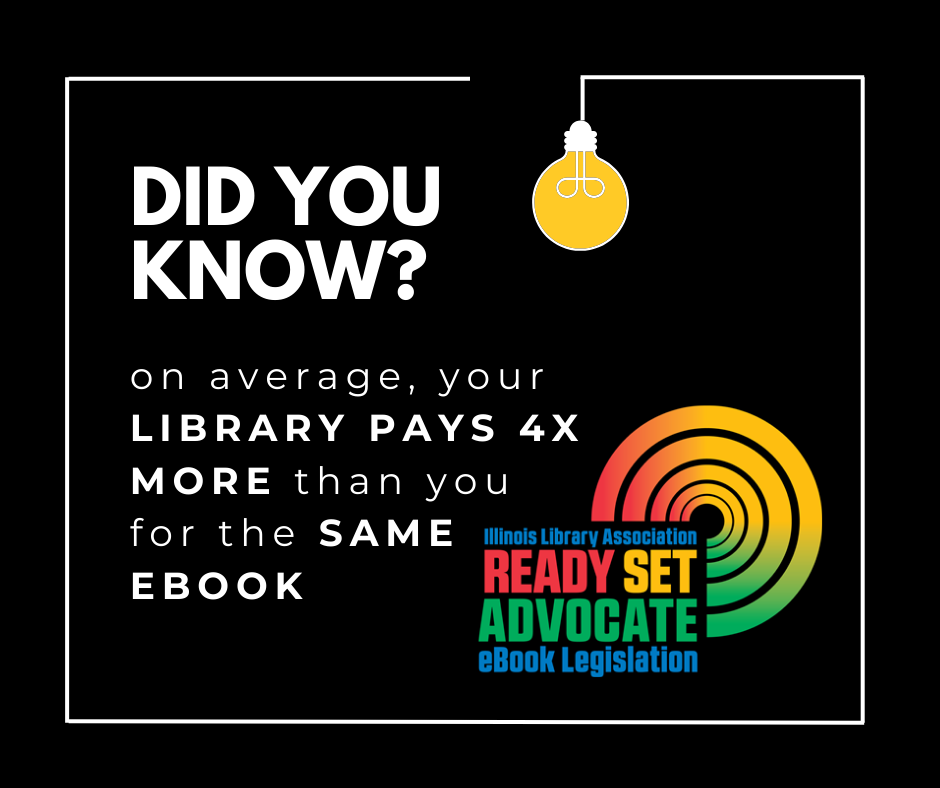
Public libraries are seeing upwards of a 200% increase over last 10 years for eBook titles. In fact, it is growing worse for eAudiobook titles where libraries are charged 3.4 time more for audio titles than the cost the public pays for the same title. The cost for eBooks is 3.9 times more than what the public pays.
Many academic libraries are zeroing out their physical book budgets to afford electronic resources to journals and eBooks.
On top of this, libraries never get to own these titles. They must be renewed after 26 checkouts (or 52 checkouts depending). We only have the right to loan, not the right to own these titles. Libraries can only “own” if a perpetual license is offered, which is not often.
Public library users are frustrated by long hold queues. What they do not know is on top of these licensing terms and high costs is a limit to lending: one copy, one user is the most common use permitted.
Why is legislation necessary?
Illinois Library Association Public Policy Committee annually solicits legislative ideas from its statewide membership. The committee received a proposal for eBook pricing legislation in years prior, and again in 2025. The goal of the proposal was Illinois libraries want fair contracts and reasonable costs. Illinois taxpayers ultimately are footing the bill for the high eBook pricing, so libraries want to be good fiscal stewards of these dollars and make their budgets go further.
Illinois is not alone in this legislative effort. Connecticut signed eBook legislation into law in May 2025. Rhode Island passed eBook pricing legislation in June 2026, and Washington DC passed passed a similar bill in May 2026. New Jersey has introduced similar legislation through Senate S4520.
So there are multiple states pursuing or have passed legislation pertaining to high eBook costs for libraries from a consumer protection and contract law perspective.
Illinois Digital Library Protection Act
Illinois House Bill 5236 is also grounded in Illinois consumer protection and contract law. It regulates contract terms, and does not mandate publisher behavior. In practice, it applies to new contracts and renewals of contracts, and is not retroactive. It prohibits violations of the Protection Act as unlawful under Illinois Consumer Fraud and Deceptive Business Practices Act, and enforcement authority is granted to the Illinois Attorney General.
Our legislative advocacy effort
Libraries traditionally have great relationships with their local legislators. We often host events and programs spearheaded by local legislators, and library support is overwhelmingly bipartisan.
If we were going push for support of the legislation, we had a solid foundation for advocating in support of the bill. We knew there would be pushback, but we also knew that our “ask” was not unreasonable: this was a taxpayer issue!
Infographics & one-page handouts
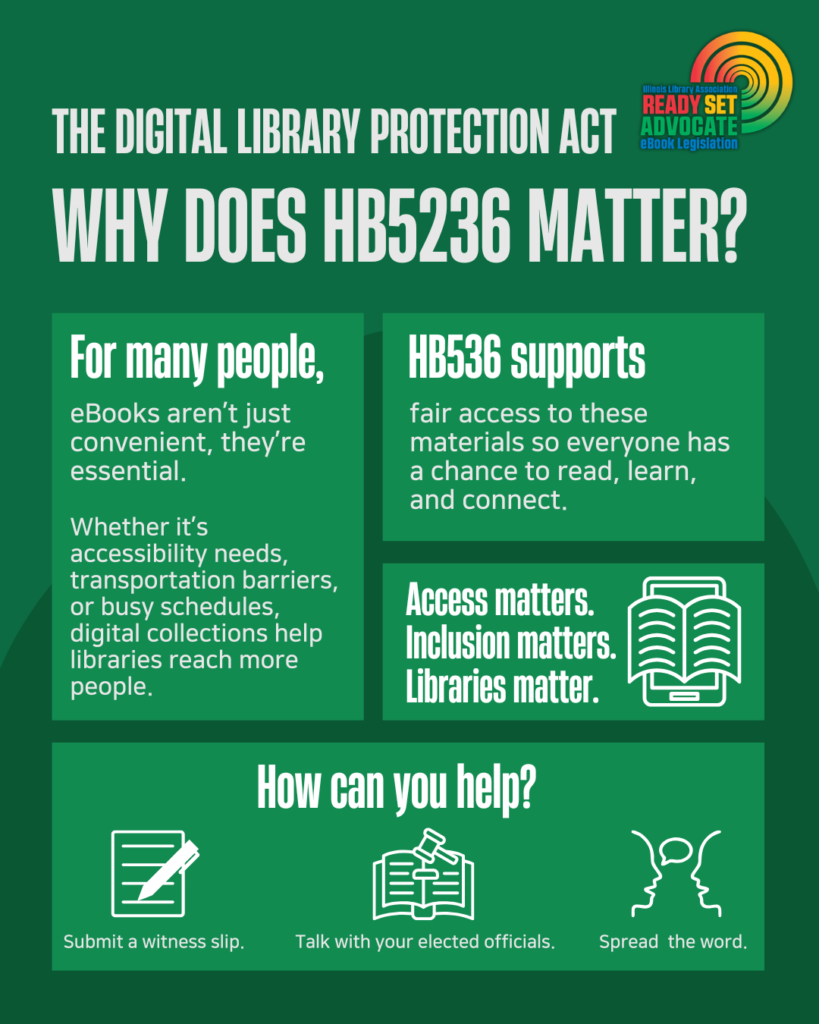
Infographics convey complex information quickly so we used these extensively throughout our legislative advocacy effort. We varied these by audience: some for the public, some for libraries, some for legislators themselves.
Bill sponsor & committee testimony
Illinois legislation was crafted with the help of the eBook Study Group, a non-profit organization led by a self-assembled, largely volunteer, small group of librarians, attorneys, and library advocates from various non-profit organizations. Our model legislation was developed by Kyle K. Courtney, a copyright lawyer and librarian, co-founder of Library Futures and the eBook Study Group.
Much credit goes to our bill sponsor, Representative Tracy Katz Muhl for submitting HB5236, the Digital Library Protection Act. Representative Katz Muhl and the Illinois Library Association lobbyist helped guide us with the process of preparing for testimony when the bill was called for a hearing at the Consumer Protection Committee. We prepared for testimony through coordinating three librarians and one local author, knowing in advance that legislative hearings can be a busy affair and to be prepared that we might only be allotted time for one person to testify. But we had our stories ready! Large and small libraries being impacted by high eBook costs, and local authors wanting to see more back listed eBook titles be purchased by libraries instead of collection budgets being consumed only by the most popular eBook titles.
HB5236 was assigned with a hearing scheduled for March 24, 2026 at 4:00 p.m. We traveled across the state and arrived at Springfield to testify in support of the legislation. Our bill sponsor nimbly led us through the hearing and we were successful in getting HB5236 passed out of committee.
HB 5236 Approved by the Illinois House 99-0
On April 17, 2026, it was brought to the House floor for a third reading. After a short debate, HB5236 passed unanimously, 99-0!
Local news coverage
The local news picked up our success in the House and began publishing stories about the legislation. This effort was in fact a specific part of our legislative strategy: to keep the legislation in the news during the summer of 2026 while we prepared for the advocacy push in the Senate.
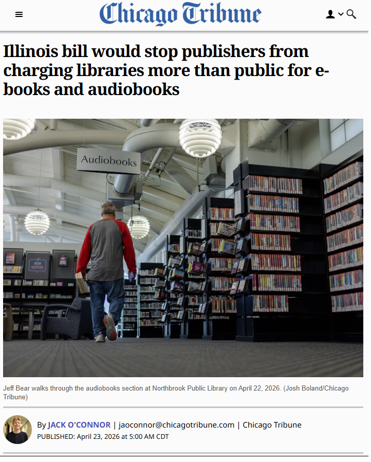
Front page of the Tuesday, April 23, 2026 Chicago Tribune print version: “Illinois bill would stop publishers from charging libraries more than public for e-books and audiobooks” Online version: “New bill has libraries wanting to be heard”
Kate Hall, executive director of the Northbrook Public Library, said the current system limits the number of books people can find while forcing libraries to repeatedly repurchase the same titles. With more money to work with, Hall and other librarians said they would look to expand their libraries’ digital book collection. For patrons, Hall said this would mean shorter hold times with libraries able to purchase more copies and more books from mid-level authors.
xxxx
Publisher FUD (Fear, Uncertainty, Doubt)
Journalists will make sure to obtain perspectives on both sides of an issue, and within the Tribune article there were quotes from The Authors Guild and Association of American Publishers CEOs.
“Author and publisher associations say the bill puts the economic livelihood of the people whose books fill library shelves in jeopardy…
“Digital access thrives nationwide today, and this bill threatens to undermine, not increase, digital access for library patrons. When publishers cannot comply with the bill’s extreme and restrictive mandates, libraries risk losing access to digital books entirely,” Association of American Publishers CEO Maria Pallante and The Authors Guild CEO Mary Rasenberger said in a joint statement. “Authors, independent bookstores, and artists across music, film, and literature all depend on the licensing framework this legislation attempts to dismantle to protect them from piracy and safeguard the modest promise of remuneration for their work.”
Note that “libraries risk losing access to digital books entirely,”according to AAP and The Authors Guild. Why would libraries lose access? The more likely scenario is publishers would embargo libraries, rather than adhere to fair pricing.
The scare tactics being used by the publishing industry to push back on the bill is one that I was familiar with in the open source software area called FUD: fear, uncertainty, doubt.
The opposition to the bill also often cite it was a violation of copyright, or that it was “extreme” despite the fact the bill was created with consumer protection as its guideposts.
Outreach in the Senate
HB5236 is currently under legal review with the Senate General Counsel, but we hope that our bill will be assigned to a committee when the Senate returns to session in the fall. My advocacy efforts continue with the Illinois Library Association and our group of incredible volunteers. We believe our legislation will help our largest libraries– Chicago Public Library– to our smallest libraries in the state, as well as our libraries in higher education and our school libraries with cost effective and fair access to resources needed for research and the enjoyment of reading.
Leave a Reply