Category: Trends

  • Illinois Library Resource Sharing: the Three Pillars

    Illinois Library Resource Sharing: the Three Pillars

    Abstract

    Illinois libraries benefit from the core infrastructure of statewide delivery, a statewide catalog, and library cooperation in the form of consortia.

    Introduction

    Library resource sharing is an incredibly robust network that is monument to what can be achieved through cooperation of local government leadership, state library leadership, and the meticulous work of library staff. Illinois provides a great example of how statewide library resource sharing should be structured through state-level services and cooperation between libraries arrived at through decades of effort.

    Library resource sharing in Illinois is supported by three major services within the state.

    1. Illinois library delivery system, which is the statewide service that links Illinois libraries together in a cohesive web where material can be exchanged between libraries.
    2. Statewide participation in a unified global catalog where library collections are updated in a single searchable platform, which for Illinois is participation in the world’s largest library catalog, called WorldCat.
    3. Participation within Local Library System Automation Programs, often referred to as “library consortium” but referred to by their official Illinois designation LLSAP. These multi-type library networks have origins in the 1970s as bringing together diverse library collections through a technological arrangement would satisfy each participating library, “although not necessarily in the same way.”

    These are the “three pillars” supporting library resource sharing in Illinois. The focus of this presentation is to outline why Illinois is a top US state in library resource sharing and to show the underlying data that shows why Illinois is one of the highest among all the United States.

    The focus of this essay will be on Illinois public libraries

    The number of public libraries in Illinois is larger than any other States with a total of 623 existing in the state. This count is supported by the data collected by the Illinois State Library as its obligation to collect data (the Illinois Public Library Annual Report, or IPLAR) which is in turn part of the annual data collection of the federal agency Institute of Museum and Library Services. The public library data collected by IMLS is posted publicly for anyone online to study and build independent observations.

    The Institute of Library and Museum Services is a U.S Federal agency that collects and compiles data of the public libraries in the U.S.A. and the ILL lending and borrowing is a metric IMLS collects for all public libraries. IMLS has released public library data since 2005, and the most recent data available for analysis was collected in 2019.

    U.S. public library resource sharing

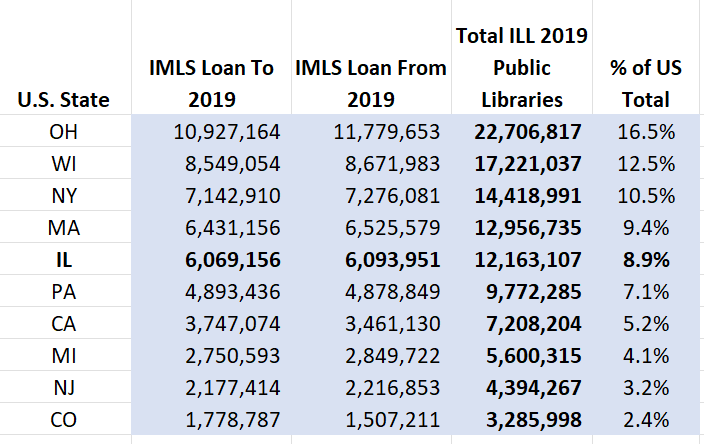
    IMLS public library data shows in 2019 that Illinois was 5th of the 50 U.S. States in total inter-library lending. Growth since 2006 is steady, doubling the total number of Illinois public library ILL by 2019. 
    Table

Description automatically generated

    Figure 1: IMLS public library data showing ILL with Illinois in bold, sorted by 2019 top 10 US States

    The reasons why Illinois is a powerhouse for library resource sharing is due to the coordination of all levels of statewide government, the regional library systems, and the efforts of library staff.

    What is Illinois resource sharing?

    Library resource sharing evolves as technology platforms emerge, change, and impact the ability of the public to find books held by public libraries. Resource sharing in Illinois is the ability to have library users perform two major functions:

    1. Walk into any public library with a valid library card, browse the open shelves of books or any material (movies, music, graphic novels, audio books), and borrow those items at that library.
    2. Request items from an Illinois library via an online system built on internet standards to be delivered to a home library of that library user.

    There are of course, some variations on those two major functions, such as newly purchased books being held exclusively for local home library users for a set number of weeks, but by and large the resource sharing covenant within Illinois is built upon those two functions as described.

    The ability to share material via an online request is called “inter-library lending” or ILL. IMLS data on ILL reflects an individual library’s tracking of its library’s sharing within a consortia and a wider resource sharing system such as WorldCat. For Illinois public libraries, the ILL data is combination of the Illinois participation in WorldCat and sharing within the libraries participating in the LLSAP.

    Resource sharing pillar #1: Illinois Library Delivery

    The delivery service established by the Illinois Secretary of State via the Illinois State Library is the glue through which statewide ILL is possible. The statewide library delivery service is the most cited service by library users, taxpayers, and Illinois legislators as fundamental to their positive experience of using a public library in Illinois. The delivery service is available to any library that qualifies for membership in one of the two regional library systems within the Illinois. 

    Regional Library System Delivery

    All 623 public libraries are members of the Illinois regional library systems, which coordinate delivery between the libraries within their service areas and connect to the statewide ILDS. Each library system closely monitors the transport of items to and from libraries, making sure efficiencies through number of stops, volume, and personnel are finely tuned to the demands.

    RAILS for example, posts its delivery “fine counts” publicly, which allows for a detailed snapshot of delivery hand counted by library staff for 1 week twice per year. During this designated week, library staff count items going through delivery sorted into each shipping container and report this data back to the library’s regional library system. The data from these counts are valuable in understanding delivery volume through the ability to share collections and request items from another library in Illinois.

    Library consortium in Illinois

    Libraries in Illinois participate in regional networks called “library consortia.” There are 8 library consortia, so by grouping library delivery counts by these consortia, a wider picture emerges of the immense volume of library collections shared within those networks as compared to the libraries not participating in the 8 groups (in this chart those libraries not in the library consortium are “standalone” designation).

    Illinois Delivery Service (ILDS)

    Think of ILDS as a highway between Illinois research and academic, university, and college libraries. Those highways then connect to the 3 regional library systems and the geographic areas they provide delivery service within.

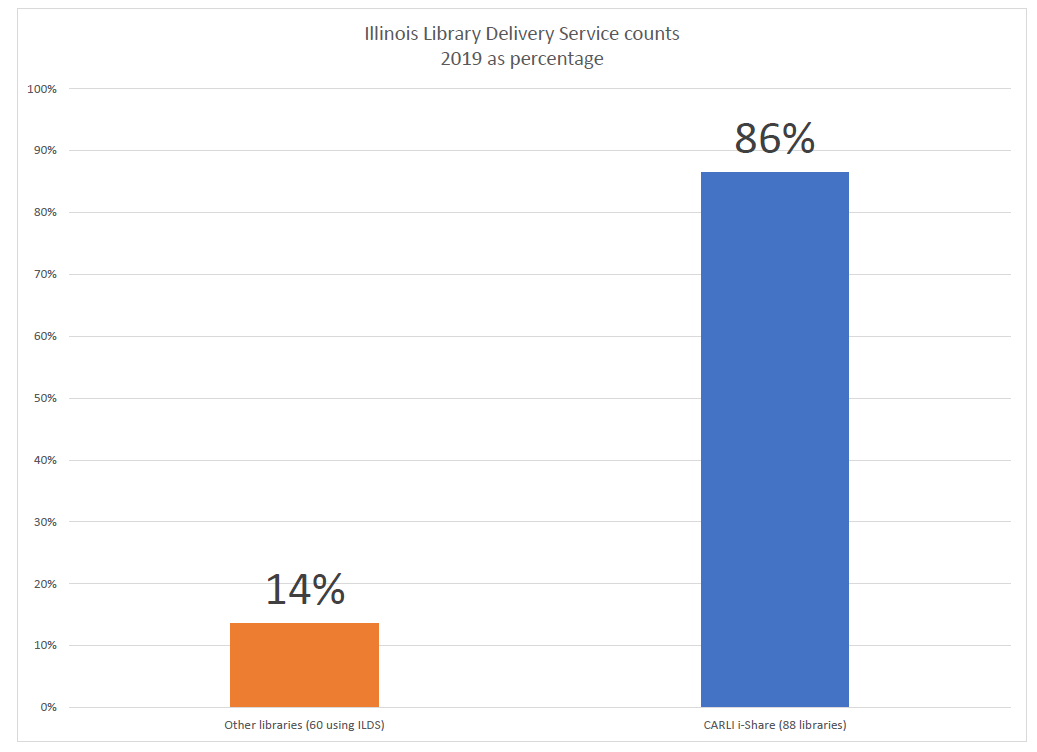
    The ILDS website provides an interface to obtain delivery counts based on a range of dates that can be selected. There are 140 academic libraries participating in the ILDS system. Within that library community is a service provided by CARLI where a catalog interface called I-Share has enabled ease of access to academic library collections. The 88 libraries participating in I-Share represent 86% of the delivery volume within ILDS.
    Chart, waterfall chart

Description automatically generated

    Figure 3: ILDS delivery counts broken down by CARLI i-Share compared to other libraries using ILDS

    Illinois Heartland Library System (IHLS)

    The regional library system providing delivery services to the southern half of Illinois collects counts on the number of items delivered to individual libraries. Heartland works closely with a single, huge library consortium called SHARE. Delivery data is not publicly posted but is available upon request. The resource sharing of the SHARE library consortia represents 93% of the IHLS delivery volume.
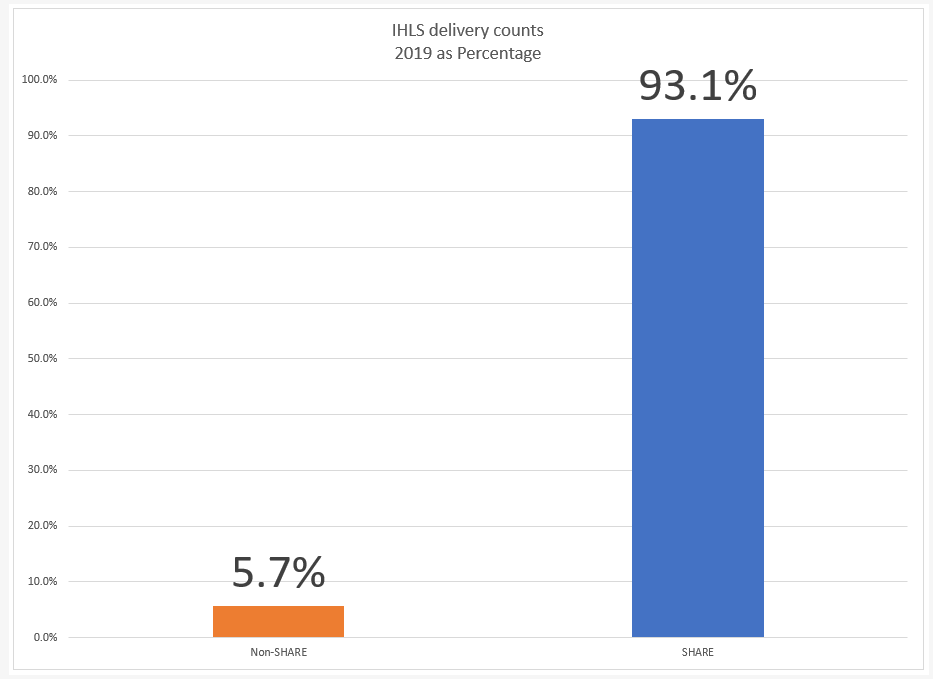
    Chart showing IHLS delivery as represented by SHARE and other libraries served by IHLS delivery

    Figure 4: Chart showing IHLS delivery as represented by SHARE and other libraries served by IHLS delivery

    RAILS delivery

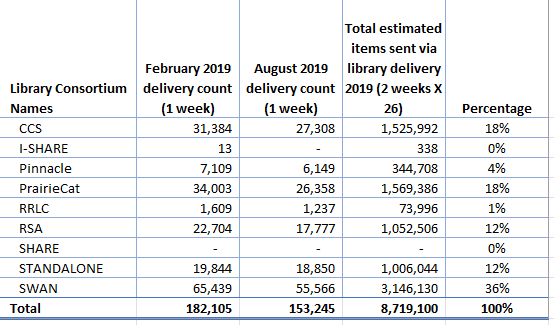
    The delivery data collected by RAILS is done each year over two 5-day periods, representing 2 weeks of the year. RAILS delivery data requires multiplying the 2 weeks of data into a full year in order to compare to the counts with IHLS. This data once compiled, and its individual libraries are affiliated with their library consortia, show heavy use of the RAILS delivery service by these groups.
    Table

Description automatically generated

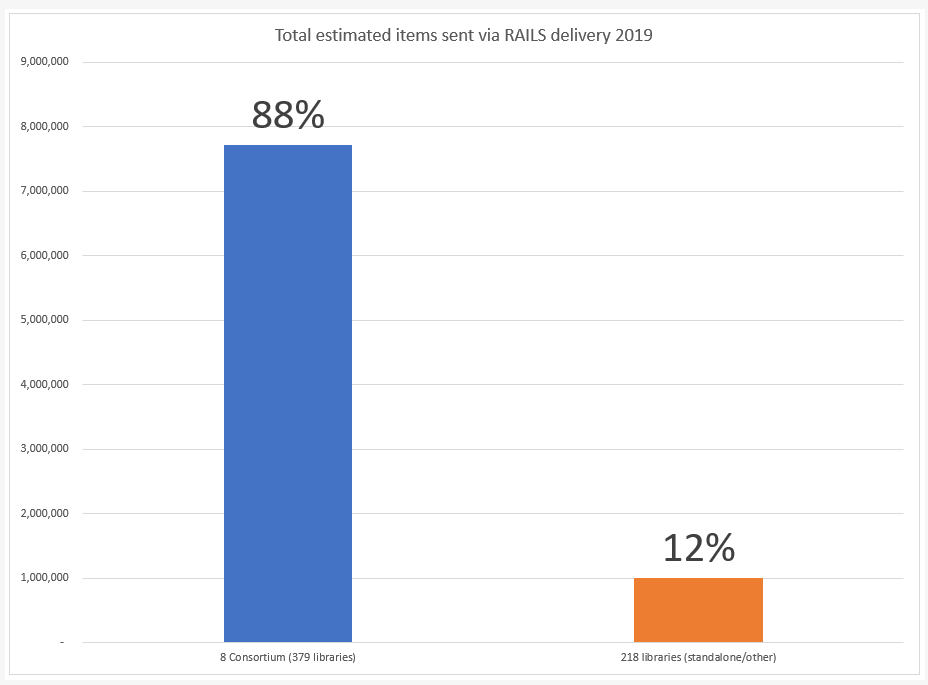
    The combined item count of RAILS delivery when grouped by the library consortia shows that delivery volume in RAILS is 88% by the libraries participating in the resource sharing groups.
    Chart, bar chart

Description automatically generated

    Figure 5: RAILS delivery counts are conducted each year, and for 2019 the library consortia are a large conributor to the delivery volume.

    ILLINET delivery

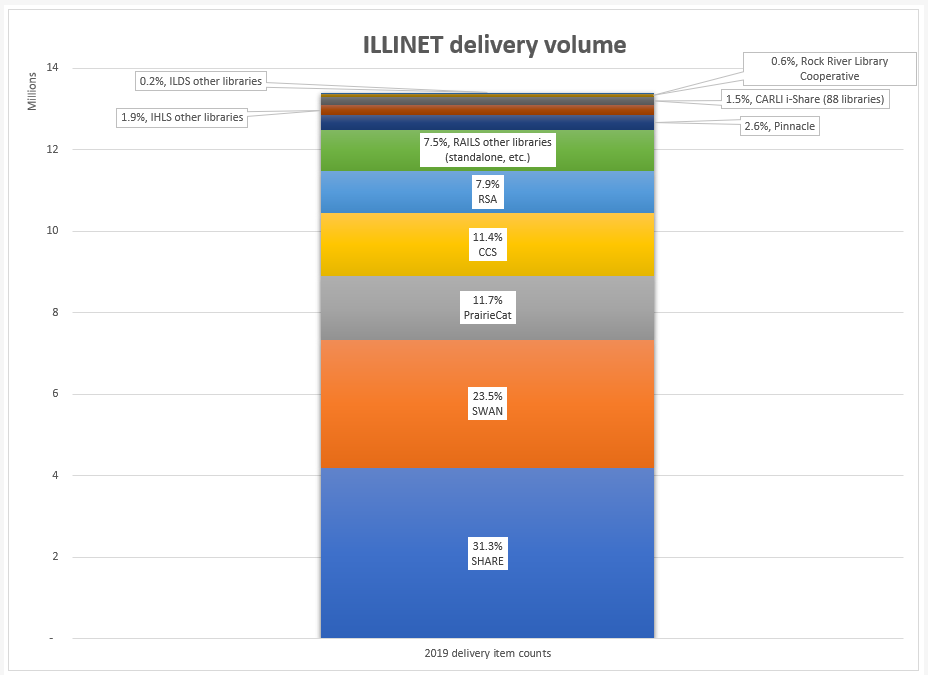
    The combined data for ILDS, RAILS, and IHLS shows the overall strength of resource sharing in Illinois where 13 million items were shared in a single year. The data also shows the power of the library consortia in maximizing the ease of requesting and borrowing material via the ILLINET delivery service.

    Table

Description automatically generated

    When taken together, ILLINET provides delivery services to all libraries, but the 8 library consortia groups make up 90% of the total delivery volume.
    ILLINET delivery total for 2019 with library consortia groups
    Figure 6: ILLINET delivery volume visualized by library group, with largest SHARE at the base.

    Resource sharing pillar #2: WorldCat is the resource sharing platform for Illinois 

    The elected Secretary of State is the official state librarian in Illinois. The department of the Secretary of State in conjunction with the Illinois State Library based in Springfield, IL has negotiated a statewide resource sharing platform for all Illinois libraries for the primary purpose of exposing collections of all Illinois libraries and allowing participating libraries to request materials. 

    Each Illinois library elects to participate in the negotiated OCLC services of which WorldCat is the public facing website for this statewide solution.

    As part of its responsibilities to libraries and the state budget, the Illinois State Library issued an RFP in 2012 for statewide services for resource sharing and bibliographic control. There were two proposals received, and a committee of statewide library representatives following Secretary of State procurement guidelines, individually graded the proposals and the State Library compiled the results. The contact was awarded to OCLC for the statewide library software platform.

    Below is a table providing an overview of the Illinois statewide catalog through WorldCat.

    FeaturesOCLC WorldCat, WorldShare, ILL, Discovery
    Illinois Statewide Cataloghttps://illinois.on.worldcat.org
    Union catalog platformOCLC WorldCat holdings are set by individual libraries and OCLC membership is required
    Library members2,945 Illinois libraries (according to OCLC Policy Directory)
    ContractNegotiated by Illinois State Library on behalf of Illinois libraries with OCLC; libraries sign agreement with Illinois State Library each year
    Size of WorldCat104 million Illinois library holdings517 million bibliographic records3 billion library holdings
    Quality controlOCLC provides various levels of data creation with stringent guidelines. Quality control is provided by peer review, reporting, and subsequent correction of cataloging errors.
    Updating holdingsOCLC WorldCat holdings are maintained by individual libraries or by consortia groups. Illinois library consortia CCS, Pinnacle, PrairieCat, RSA, SHARE, and SWAN update WorldCat monthly. SWAN library holdings in OCLC have a real-time status with a Z39.50 connector.
    Vendor cataloging servicesOCLC’s “WorldCat Cataloging Partners” works with a multitude of vendors. The library orders materials from vendor partners. The vendors then transmit to OCLC the lists of titles ordered. OCLC delivers the full MARC records to SWAN, and the library’s holdings are automatically set in OCLC.Multiple national libraries represent catalog records and holdings in OCLC, providing a large repository of foreign language materials.
    Interlibrary Loan ScopeWorldwidez39.50 availability offers real-time availability status check.IFM (Interlibrary Loan Fee Management) available for out-of-state, special arrangements (libraries may receive fees for lending material out of state to cover costs)
    Document DeliveryArticle Exchange provided electronic delivery of full-text articles through the OCLC knowledge base, TOC, etc. Article Exchange electronic secure transmission can also be used internally to support patron services.
    Benefits to Illinois libraries & residentsEnormous database of 517 million records in all formats and languagesWorldwide resource sharing (inter-library loan) componentStringent quality controlMonthly holdings update can restrict extract of material ineligible for interlibrary loan.

    WorldCat by the numbers

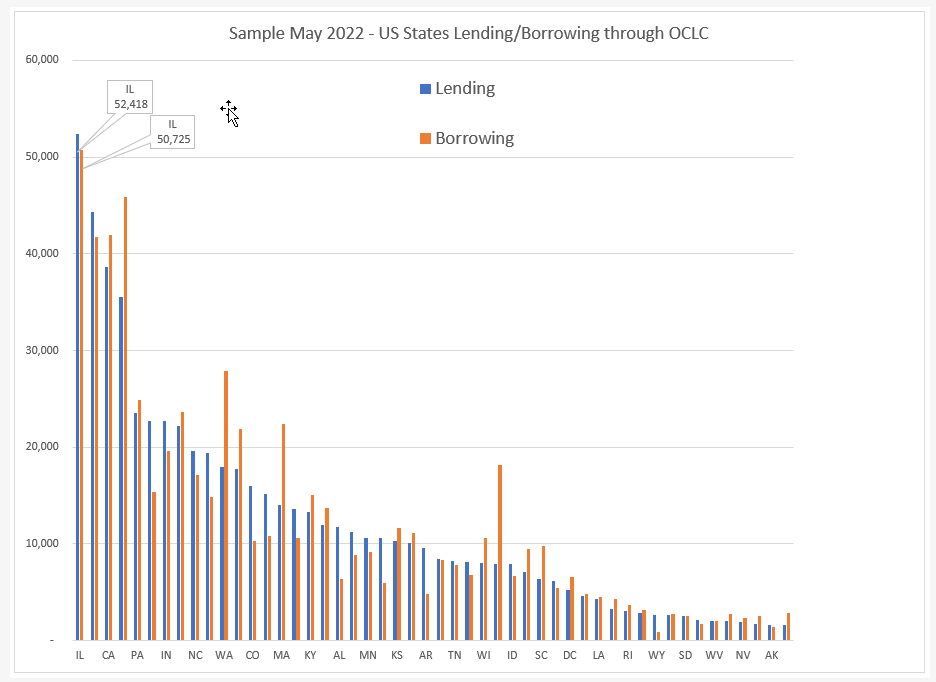
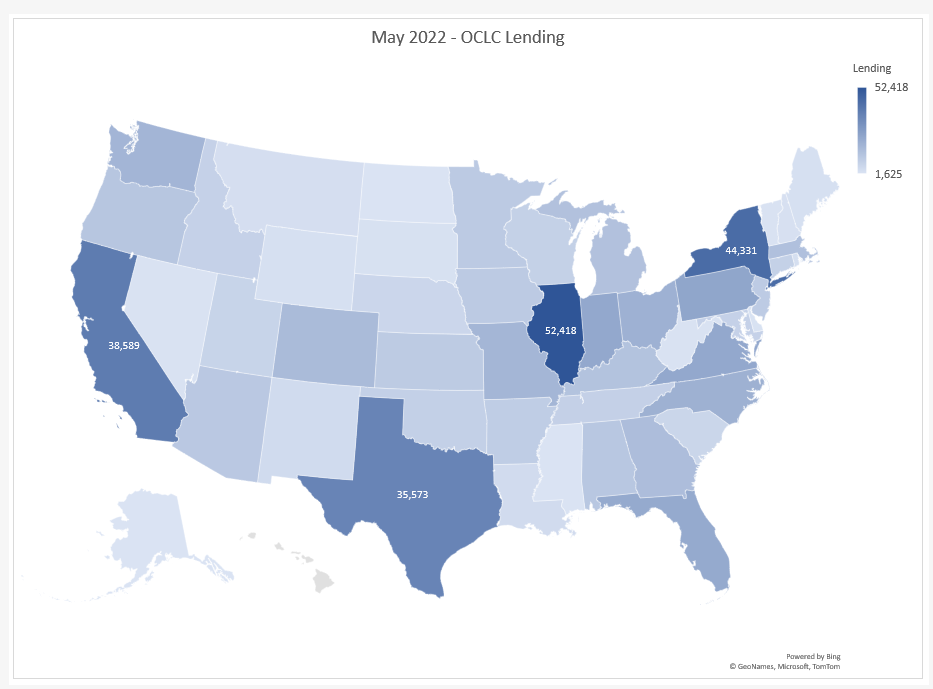
    Illinois statewide catalog built through library cooperation has eye-popping numbers. OCLC WorldCat recently shared the May 2022 numbers for ILL requests made on its WorldCat and WorldShare platform. Illinois is the top lender and top borrower among the 50 US States within OCLC WorldShare ILL.
    Chart

Description automatically generated

    Figure 6: OCLC WorldShare ILL data for May 2022 shows Illinois is the #1 user of the OCLC service. In addition, Illinois is a net lender which shows the national and global reach of OCLC benefits Illinois libraries.

    The statistical data provides ample evidence that Illinois libraries request a robust software solution for sharing collections between Illinois libraries, but that also providing Illinois residents access to out of state materials is vital. The reciprocity of this arrangement cannot be overstated: support of a nationwide network of libraries via the OCLC WorldCat is a major benefit to Illinois library users, and to the needs of libraries throughout the country.
    Map

Description automatically generated

    Figure 7: One month snapshot shows Illinois beats New York, California, and Texas for lending and borrowing within OCLC.

    Resource sharing pillar #3: Library consortium are leaders for Illinois resource sharing

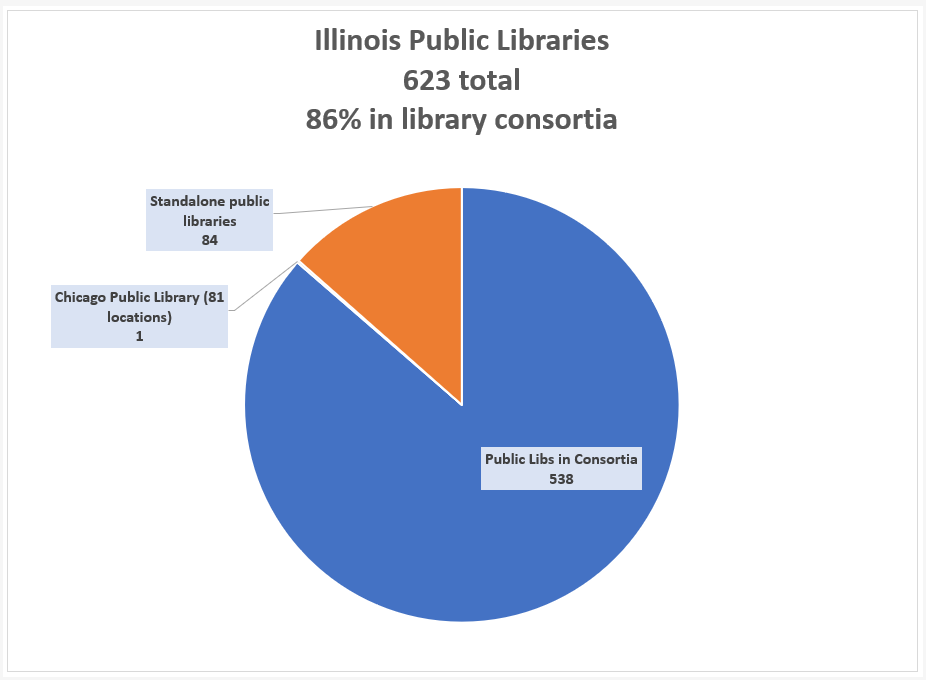
    The total number of public libraries in Illinois is 623, of which 538 are participating in a library consortium. The remaining 85 public libraries that are not participating in an LLSAP represent 14% of the Illinois public libraries. LLSAP participation levels have been steadily growing among the Illinois public libraries.

    86% of Illinois public libraries are library consortium members

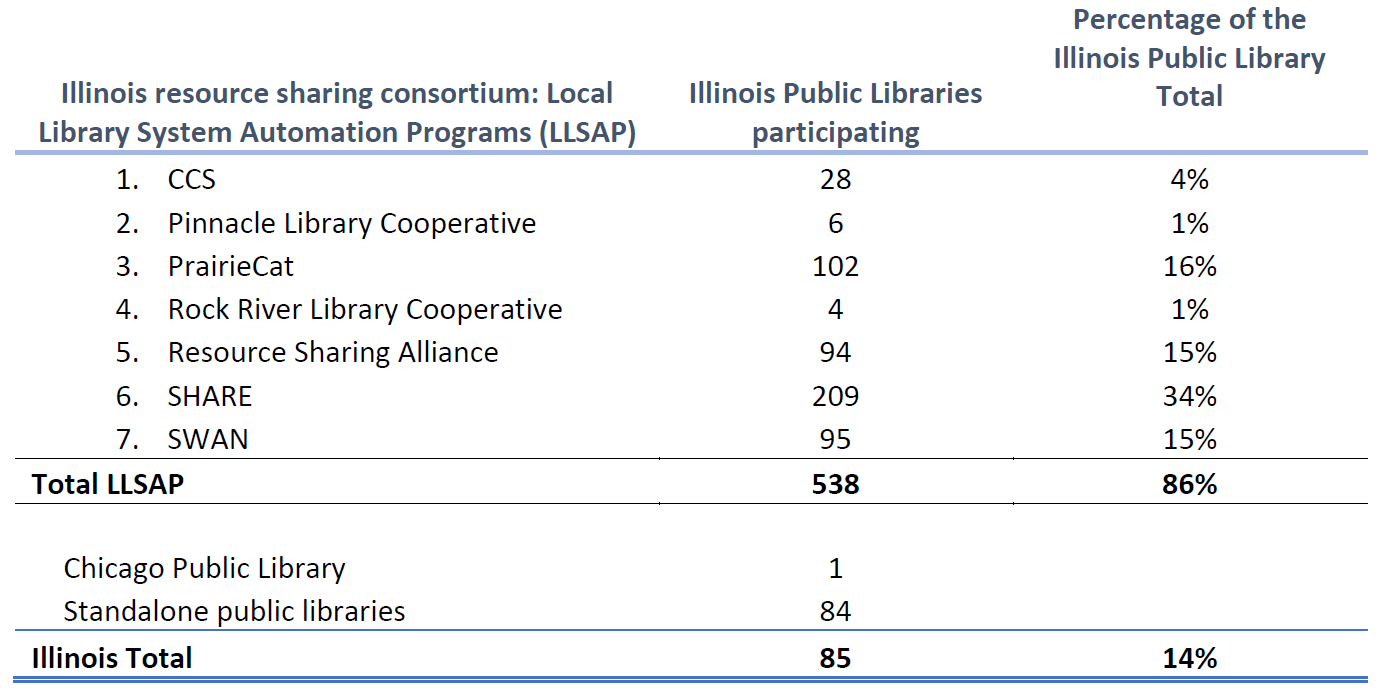
    There are the 7 library consortium/LLSAP in Illinois. Their size based on participating library varies: some have large numbers of school district libraries participating (PrairieCat and Resource Sharing Alliance), while others are exclusively public libraries (CCS and Pinnacle). One important aspect of LLSAP membership is that it is voluntary: there are no defined boundaries for Illinois library consortium, and no state requirements that a public library must participate. The 538 public libraries in Illinois have arrived at decision to participate at the local level through its trustees, staff, and leadership. These 7 library consortium are some of the finest examples of regional cooperation of local library entities. Those libraries have representation within the group, established through organization bylaws and policies. Libraries pay to be members of the LLSAP and have voting rights within the cooperative. 
    Chart, pie chart

Description automatically generated

    The chart below shows only the public libraries participating within the LLSAP.
    Table

Description automatically generated

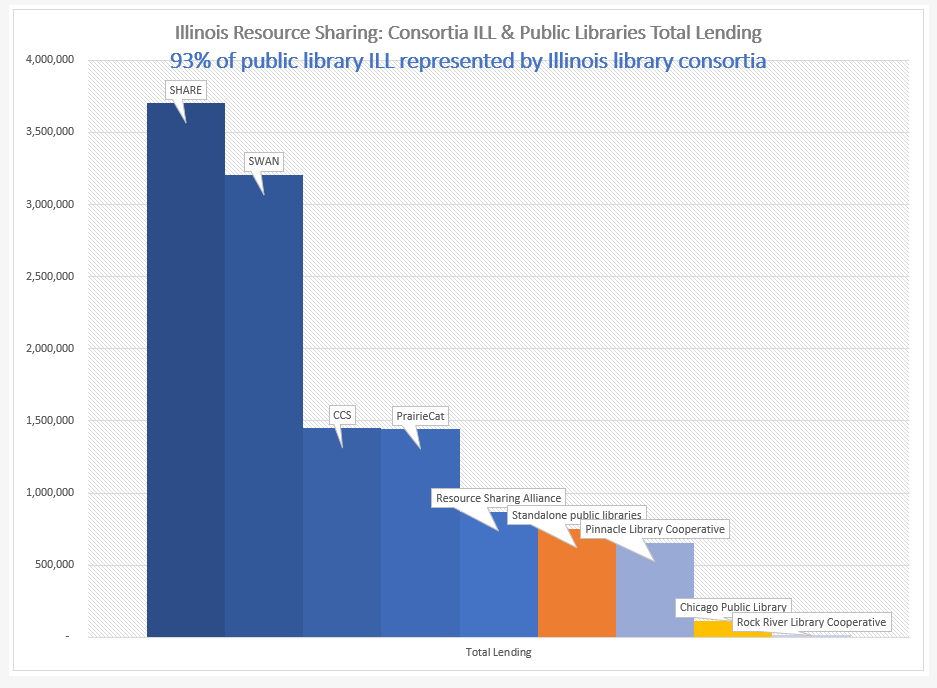
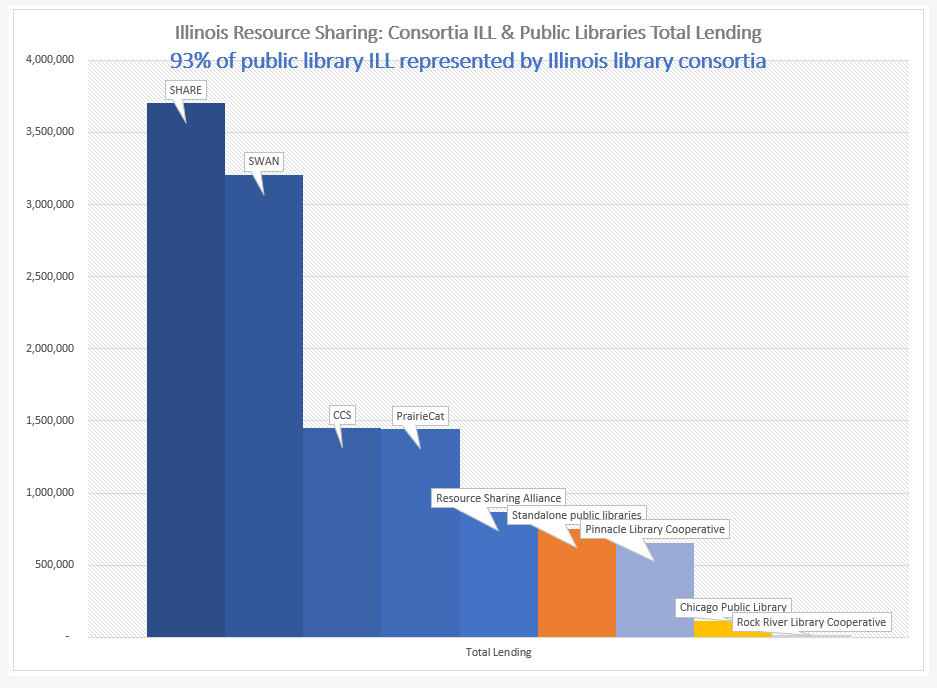
    LLSAP resource sharing among Illinois public libraries represents 93% of the total

    Library membership within an LLSAP is not indicated as part of the annual report and are not therefore reflected in the IMLS data. But a simple cross reference of 2019 membership of public libraries within LLSAP reveals that the public libraries participating in Illinois consortium make up a staggering 93% of the resource sharing within the state. 
    Chart, histogram

Description automatically generated
    Graphical user interface

Description automatically generated with medium confidence

    Library eBook usage is not overtaking resource sharing

    If one were thinking that the future of sharing library collections is waning, while the use of library eBooks is waxing, the data tells us otherwise. eBooks within U.S. public libraries has been a featured service for some time now, running in parallel with traditional collections of books, audiobooks, films, and music. Perhaps the growth of eBook usage in Illinois public libraries will eventually overtake the need for the resource sharing infrastructure as described?

    Fortunately, the size of eBook collections, their expense, and their usage has been tracked by IMLS for well over a decade now. The Illinois public library IMLS data shows a steady growth of eBook collections offered to the public has increasing use. But this service has not undercut the demand by the public for the core services of popular collections of physical books, audiobooks, films, and music. 
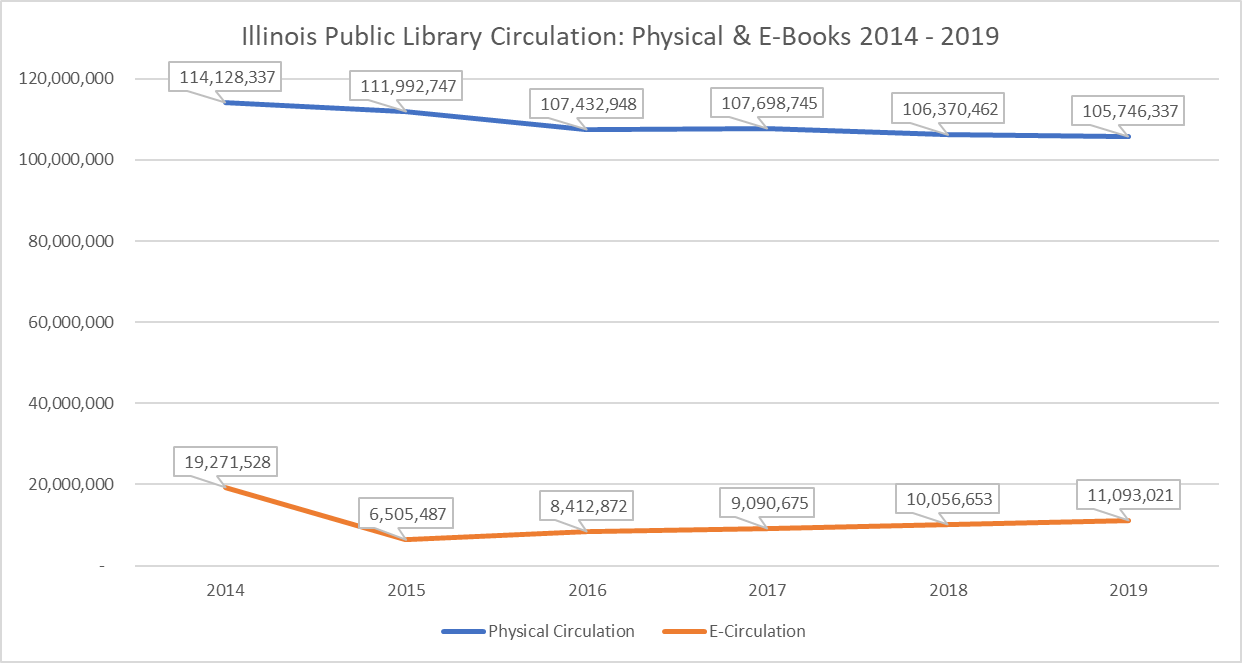
    Figure 8: IMLS data on physical items circulation (blue) versus the use of Electronic Materials (orange). The IMLS report on eBooks is the “total annual circulation of all electronic materials,” and is compared to total circulation of physical collections. Note: 2014 data collected by Illinois and submitted to IMLS appears to be inflated as it is the first year of the e-circulation data collection

    E-book circulation in 2019 is only 10% of the total physical circulation for the 623 public libraries in Illinois. If it appears that public library circulation from 2014 to 2019 is falling, it is worth noting that physical circulation has been slowly decreasing each year since its meteoric 19% increase in 2010 during the Great Recession. Illinois public libraries are reverting to the 2006 mean in terms of total circulation.

    In conclusion, eBook collections and its growing usage by public library users should be supported, but its usage data in comparison to the core library collections remains low in comparison to collection circulation.

    Conclusion: What are we to make of the Illinois resource sharing numbers?

    Here is a summary of resource sharing for public libraries in Illinois.

    • 86% of the Illinois public libraries participate in a library consortium
    • 90% of Illinois ILLINET delivery volume is connected to 8 library consortia, with 88% of RAILS delivery and 93% of IHLS delivery originating in consortia member libraries
    • Illinois libraries share more than any other US state using OCLC WorldCat (via OCLC WorldShare ILL)
    • Public libraries participating in LLSAP/consortia contribute 93% of the ILL within Illinois public libraries
    • The standalone libraries contribute 7% of the ILL within Illinois, yet represent 41% of the total spending on public libraries
    • eBook usage is 10% compared to the total circulation of physical collections in Illinois 623 public libraries

    The amount of sharing between public libraries in Illinois is something all public library staff and state leadership should be proud of. This sharing of collections is built on the achievement of decades of library staff following technical standards set by state and regional leadership. Illinois achievement for resource sharing was built on the dedicated careers and labor of many library workers.

    Recommendations

    1. Resource sharing among Illinois libraries as a priority of the Secretary of State and the Illinois State Library should be to fund the three pillars of resource sharing to its fullest levels: Illinois delivery, WorldCat participation, and LLSAP participation. Any reduction of State funding to any of the three pillars in favor of eBooks or other e-content ignores the evidence that public library users strongly favor physical collections over e-content.
    2. Participation in WorldCat is a major benefit to Illinois libraries as a single, unified inventory of all library collections. The public libraries in Illinois require a sophisticated solution that WorldCat provides through its ability to connect Illinois libraries to any library in the 50 states.
    3. LLSAP funding at the state level should be increased at every opportunity, as the contributions of those libraries within those 7 groups maintains the highest level of access to Illinois residents to all the collections of 623 public libraries. State funding to LLSAPs via library systems is the only funding source available to the 7 LLSAP, as the Illinois State Library and Federal agencies such as IMLS have no programs available for LLSAP to apply or petition for funding.

    References

    Data used in this analysis the is publicly available and is supplied below in a simplified set.
    OCLC lending & borrowing

    IMLS ILL data

    Illinois delivery data

    IMLS Public Libraries Survey

    RAILS delivery count

    ILDS delivery statistics

  • The Radical Purpose of Illinois Library Consortia

    The Radical Purpose of Illinois Library Consortia

    Abstract
    The purpose of library resource sharing consortia is not understood. The proper definition is that Illinois library consortia are organized apparatus for addressing the wide range of inequity and historic racism within Illinois, while saving taxpayers millions of dollars annually.

    Resource sharing is the core purpose

    The definition of what are Illinois library consortium within the various types possible, the “library resource sharing consortium” is the most accurate. The various models and types are explained by Valerie Horton and Greg Pronevitz’ s compilation of essays in ALA Publication, Library Consortia: Models for Collaboration and Sustainability.

    “From a philosophical perspective, libraries join together to advance research and learning as well as to expand access to wider resource pools. Other reasons to cooperate include sharing continuing education and obtaining expertise in high-cost staff areas such as technology.” [1]

    Library resource sharing: the basics

    The Illinois Library and Information Network (ILLINET) was created in 1975 as a statewide “library alliance” to expand access to library resources to the citizens of Illinois. With its preface, ILLINET Library Loan Code outlines that “libraries collectively provide a strong foundation for statewide resource sharing to meet the diverse information needs of Illinois citizens.” [2]

    Resource sharing within the Illinois alliance is defined as “making the collections of one library available to the patrons of another library efficiently and effectively. Resource sharing encompasses the technical capabilities, staff expertise and policies necessary to achieve that objective. Resource sharing incorporates activities related to automated discovery tools (including bibliographic library databases), collection management, bibliographic description, delivery, interlibrary loan, reciprocal access, and reciprocal borrowing. Resource sharing is a core system service.” [Emphasis added]

    ILLINET defines a library consortium as “a group of libraries formally organized to promote common interests and achieve common goals, of which interlibrary loan and resource sharing activities are typical examples.”

    And finally, the ILLINET interlibrary library loan guide defines the Local Library System Automation Program, or LLSAP, as “an integrated library system open to membership by full library system members of all types developed by or receiving financial or in kind support from a library system.”

    Illinois library consortium

    Now that the formal definitions are established, it is important for Illinois libraries to understand the deeper purpose of these organizations through comparison with other states. We will need to do this by taking a larger view of public library annually reported data, collected by the Illinois Public Library Annual Report (IPLAR), and compiled by the Institute of Museum and Library Services (IMLS) at the federal level. Every US state and territory with public libraries can be studied and compared using this publicly available data.

    Comparing US states by population with Illinois, you will find that Ohio has a population very close to Illinois. Both states have large metropolitan areas, with major cities Cleveland, Columbus, Cincinnati, and Toledo, compared to Illinois cities Chicago, Aurora, Peoria, and Rockford. Not to mention the huge suburban area surrounding Chicago in the counties Cook, DuPage, Kane, and Will county, compared with the Cuyahoga and Medina counties in Ohio. [3]

    While Ohio is very similar to Illinois in its population, it has a much different ratio of local, state, and federal funding. IMLS Public Library Statistics from FY2019 show the stark difference of how Ohio manages funding at the state level versus Illinois. Illinois has 623 public libraries compared to Ohio’s 251. This means Illinois has 2.5 times more public libraries than Ohio.

    Illinois has an overabundance of public libraries

    At its most basic level, the funding per public library is starkly different in Ohio compared to Illinois because funding in Illinois must be stretched 2.5 times further than Ohio. The huge number of public libraries in Illinois dilutes the funding available to each organization. Illinois public libraries are funded 39% less than Ohio’s public libraries.

    Figure 1: IMLS data FY2019 Illinois & Ohio public libraries

    Making matters worse for Illinois, Ohio also has a very different percentage of funding distribution compared to Illinois. Ohio public libraries rely on local property taxes for 46.3% of their annual budget, whereas Illinois public libraries rely on local property taxes up to 90.9%. Ohio has nearly equal public library funding from state and local distribution. In Illinois, federal and state funding barely reaches 4%.

    Figure 2: IMLS table 7 from FY2019 comparing Colorado, Illinois, Missouri, and Ohio

    Public library funding in Ohio at the state level is 12 times higher than state funding in Illinois. With Illinois public libraries depending so much more on local property taxes than Ohio, the need for active and organized efforts to equalize library services in Illinois points towards state funding elsewhere to help with the inequality.

    Ohio public libraries compared to Illinois public libraries

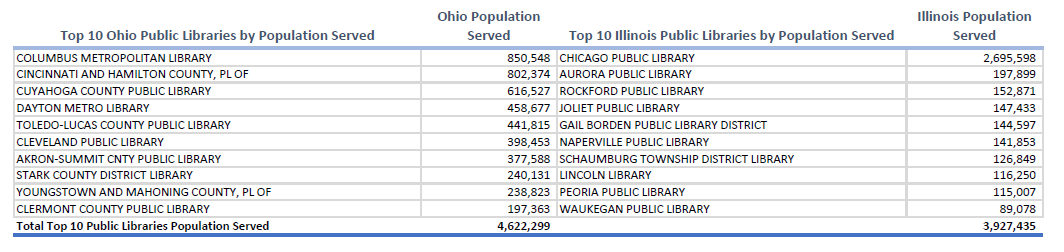
    At a glance, you might think Ohio having only 251 public libraries versus 623 in Illinois is a bad thing for Ohio’s residents. But where is that $9 million in funding going to public libraries in Ohio? Ohio, quite simply, has large, multibranch county library systems. Illinois does not. Ohio has the Cuyahoga County Public Library System. The Cook County Public Library does not exist.

    Figure 3: Top 10 population served in Ohio vs Illinois

    None of the top 10 most populous Illinois libraries are a county system, while 7 of Ohio’s 10 are county systems. It is worth pointing out that Cleveland Public Library participates and supports CLEVNET resource sharing consortium with 45 public libraries participating in Northern Ohio.

    The overabundance of public libraries in Illinois dilutes the average library’s ability to deliver adequate services. There is, however, an existing solution in Illinois to help with this disparity: the creation of large, multitype library resource sharing consortium.

    Illinois library consortia reduce tax dollars

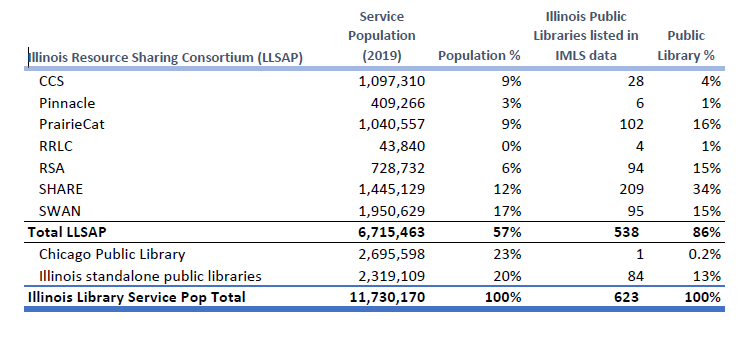
    Illinois resource sharing consortium are 7 huge technology platforms spanning multiple counties in the state. They are, on the whole, intergovernmental entities, subject to all the laws of local government. One exists as Not For Profit (Resource Sharing Alliance, NFP), but they all have governing boards, bylaws, budgets, fiscal audits, and a lot of users. The official funding designation in Illinois for these 7 entities are Local Library System Automation Programs, or LLSAPs. In Illinois, the LLSAP provide services to 57% of the population in the state. Chicago Public Library is the largest public library in Illinois representing 23% of the total library service population encompassing 81 branches (it is also its own Illinois regional library system, functioning more like a large county system). There are 538 public libraries in an LLSAP representing 86% of the Illinois total of 623 public libraries. If you were to consider Chicago Public Library as the LLSAP of Chicago Public Library System, the total population served by LLSAP would be 9.4 million or around 80% of the total Illinois population. [4]

    Figure 4: Public library IMLS data compiled under LLSAP

    The savings are clear for any public library joining an Illinois library consortium. Over the past five years, the libraries Lansing, Roselle, Glenside, and Warrenville all joined the SWAN resource sharing consortium and saved on average $60,000 annually through the joint cost saving effort of the SWAN group. On software licensing and ILS staffing expenses alone versus what they would pay for consortium membership, SWAN is saving 100 libraries a total savings of $6 million every year. [5]

    Illinois library consortium offer services that go beyond that of resource sharing. Through concentrated efforts, the LLSAP in Illinois offer centralized services that would have been duplicative at the local level. These activities include:

    • Cataloging
    • Purchasing
    • Managing software
    • Administering integrated library systems software, servers, catalogs
    • Managing security of data, software updates and upgrades
    • Providing data analysis of local library collections, cardholders, and usage
    • Tracking and reimbursing any material unreturned through sharing collections
    • Consulting on new ideas and sharing best practices among libraries

    Personnel savings is a huge cost savings being provided by the existence of LLSAP. If every consortium member was required to hire a single full-time cataloging librarian, it would total $28 million annually for those 538 libraries. [6] As an example, SWAN has 5.5 full-time staff serving 100 libraries as a centralized cataloging service.

    Illinois Library Consortia Collection savings

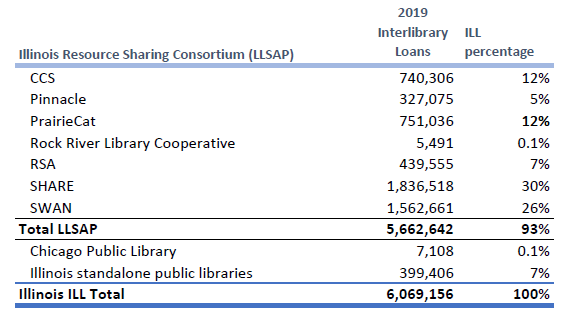
    The amount of savings achieved through the creation of huge, shared library collections online can also be determined. An analysis of IMLS data from 2019 shows a staggering amount of interlibrary lending between public libraries in Illinois, which is the 5th highest of the 50 US states.

    Figure 5: IMLS 2019 ILL “LOAN TO” counts are public libraries lending collection material out to another requesting library. Chicago Public Library percentage is 0.1% of the state total

    If there was no ability to easily lend material between libraries via the LLSAP, the local library would have to either acquire that material or forego the purchase. Assuming the average item purchase price is $20, the total amount 5,622,642 in items loaned would be $112.5 million dollars.

    Illinois library consortia address inequity

    Illinois public library funding is derived 91% from local property taxes. Public libraries determine an amount of money they need to operate, and that total dollar amount is collected through the county treasurer through property taxes.

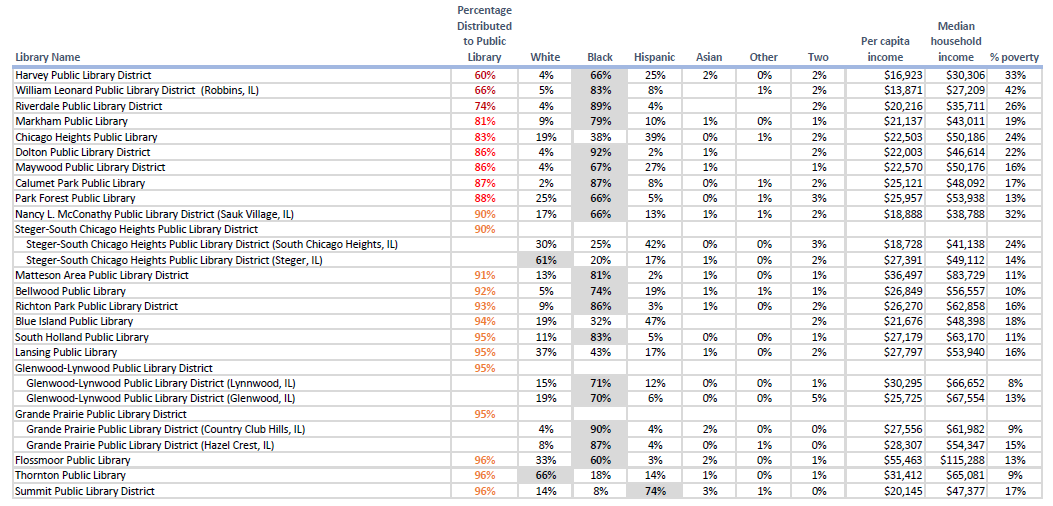
    The troubling truth is that for some public libraries, the amount of tax dollars collected will fall far short of what is needed to run the library. Any public library receiving less than 10% of its requested funding is an immediate crisis for basic operations. Think of a local business surviving a 10% loss year after year.

    Figure 6: Analysis of 95 SWAN public libraries show 23 of 95 are receiving less than 97% funding. Data is sorted by % taxes distributed. Bold/gray cells in table note racial % is over 50%.

    And if you look closely at the communities where the funding shortfall occurs, you will see this primarily impacts communities of color.

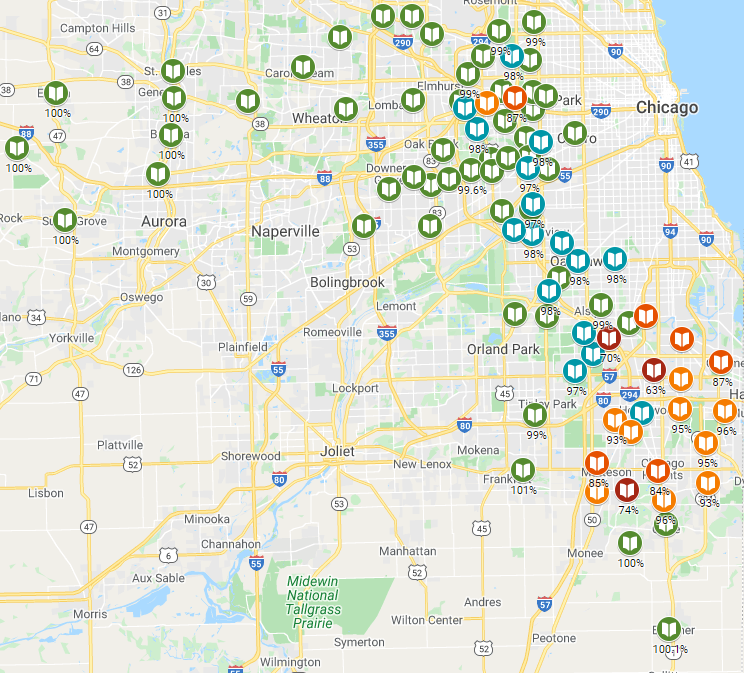
    Figure 7: Suburban public library funding distributions: the public libraries indicated in red have less than 97% of taxes distributed
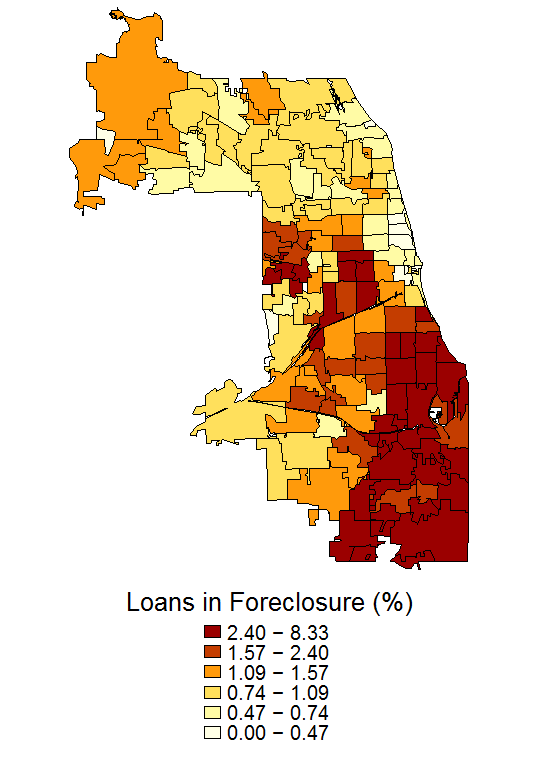
    Figure 8: Chicago area property foreclosure
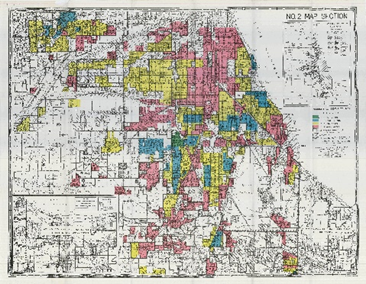
    Chicago and southern suburban area from 1940 Home Owners Loan Corporation map with redlined neighborhoods
    Figure 9: Chicago area redlining map

    The Federal Reserve Bank of Chicago issued this foreclosure map for Cook County. The redlining in Chicagoland is available on this map created by the Home Owners Loan Corporation in 1940. Those libraries experiencing funding shortfalls are within those housing redlines, which is an established form of systematic racism in the United States that made it difficult or impossible for people in certain areas to access mortgage financing and thus become homeowners. [7]

    The SWAN library consortium has 23 of its 100 member libraries under 97% funding. Yet, the same number of software and services are provided equally between SWAN members. The consortium has no service level tiers or add-on costs for participating libraries. The membership fee structure for public libraries is based on taxes distributed, so the libraries struggling with hardship due to a weak local tax base are factored within the cost to participate. Remarkably, within SWAN’s membership boundaries, resource sharing remains extremely high with those 23 libraries suffering funding shortfalls and the other libraries. Even during the two-years of global pandemic, interlibrary lending within SWAN has remained at 2019 levels.

    Conclusion: Illinois library consortia serve a radical purpose

    Illinois library consortia should not be viewed solely as a “hosted ILS” or a “shared catalog.” Consortia services provided to member libraries are distributed equally, without tiers or by ala carte expenses. The Illinois resource sharing consortia fill the missing role that county wide public libraries have within Ohio in bridging communities harmed by racial inequality.

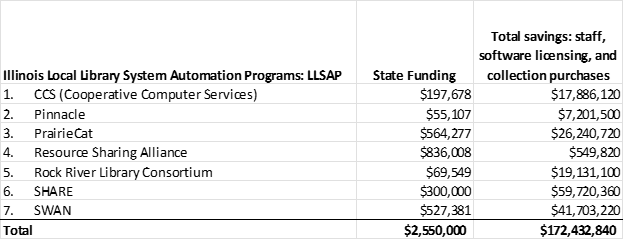
    The funding of library resource sharing consortium in Illinois should not only be maintained, but expanded, due to the huge cost savings and equitable access achieved through the alliance of participating libraries. The absence of the six LLSAP would result in $172 million total in additional expenses for the Illinois taxpayer.

    Library resource sharing consortium fuse together altruism and fiscal stewardship. The willingness of expanding resource sharing among libraries fits perfectly alongside the tax dollar hawk in Illinois. Both constituents are rewarded through library collaboration at the library consortium level.

    As a reminder, Illinois regional library systems are required to support LLSAP. The Illinois State Library defines the purpose of the regional library system as the following:

    Illinois Library Systems are funded by annual system area and per capita grants from the Illinois State Library to serve the communities in their geographic area. This creates a network of cooperative library resource sharing accessible to Illinois residents. The key functions of the library systems include the administration of online consortial catalogs, known as Local Library System Automation Programs (LLSAPs), support for resource sharing and library system delivery service. [8]

    There are three regional library systems in Illinois: Chicago Public Library System, Illinois Heartland Library System, and Reaching Across Illinois Library System. Within those library systems are the following seven LLSAP.

    Figure 10: State funding numbers for the 7 LLSAP and the calculated savings based on ILL, centralized staffing, and software

    Please support the funding of the seven Illinois LLSAP and the expansion of funding for those entities. The state funding investment is nearly $172 million savings for taxpayers: around 70 times the total investment.

    End notes:

    1. Library Consortia: Models for Collaboration and Sustainability, ALA Publishing, https://www.alastore.ala.org/content/library-consortia-models-collaboration-and-sustainability
    2. The Illinois Library and Information Network can be found on the Illinois Secretary of State’s Office website: https://www.ilsos.gov/departments/library/libraries/illinet.html
    3. The latest statistics available as of January 2022 encompasses the year prior to the global pandemic can be found online: https://imls.gov/research-tools/data-collection
    4. IMLS population data per public library in FY2019 has LLSAPs a 6,715,463 service population of 11,730,170 IMLS Illinois total. Chicago Public Library service population is 2,695,598 representing 23% of the total for Illinois.
    5. The expenses of standalone public libraries Glenside, Roselle, and Warrenville included Library Vendor Annual Maintenance (Innovative Polaris, Sierra, SirsiDynix, etc.), Hosting/SaaS of Library Services Platform, Enhanced Content Subscription (Content Café, Syndetic, etc.), OCLC annual subscription, Authority Service Updates (MARCIVE, vendor, etc.), EBSCO Discovery Service, EBSCO Novelist Select, Proxy Service (OCLC Ezproxy, OpenAthens, etc.), Mobile app (Capira, Boopsie, library vendor provided, etc.), Server Licensing (on-premise server support maintenance, warranty, etc.), Notice printing cost (postage, Unique Management MessageBee, local supplies, etc.), Patron notification via Text (Shoutbomb, etc.), Patron notification via Automated Telephony (local on-premise, Unique Management service, etc.), Library staff supporting ILS (salary, benefits, etc.), Cost spent attending vendor user event (Innovative Users Group, COSUGI, etc.)
    6. Assumes cataloging position is $50,000 annually.
    7. See SWAN tax analysis on Google Maps: https://www.google.com/maps/d/edit?hl=en&mid=13icXfJDPR3WHXJKY7EFJqim02h1ZPGUu&ll=41.74854858620986%2C-88.25241121577699&z=10
    8. https://www.ilsos.gov/departments/library/libraries/libsystems.html

  • OCLC Holdings Manager: a primer

    OCLC Holdings Manager: a primer

    The OCLC Holdings Manager is a project posted to GitHub as a licensed open source solution for any library in the world to download and use or improve upon. SWAN designed OCLC Holdings Manager (OHM) with OCLC Developer Network using the WorldCat Metadata API. The system is responsible for updating 25 million WorldCat holdings annually, which is 25% of the 104 million holding records for Illinois. The basics of how it works is described on the introductory readme.md of the Github project:

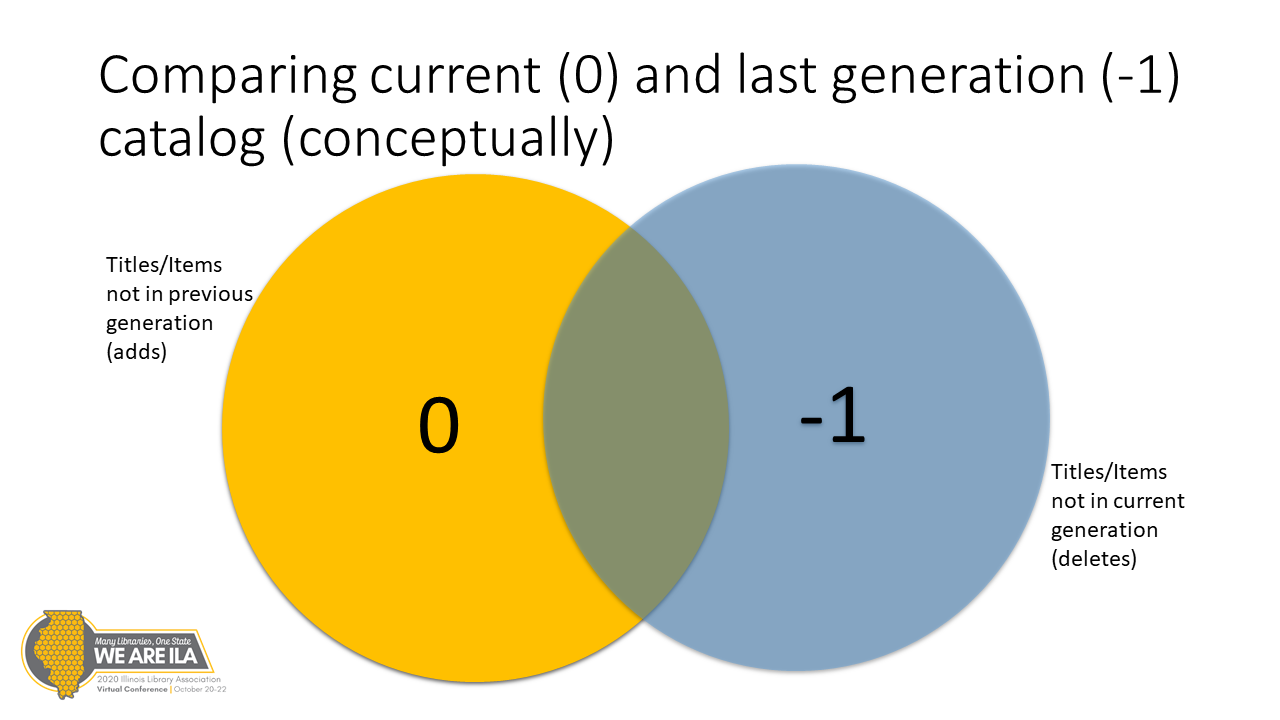
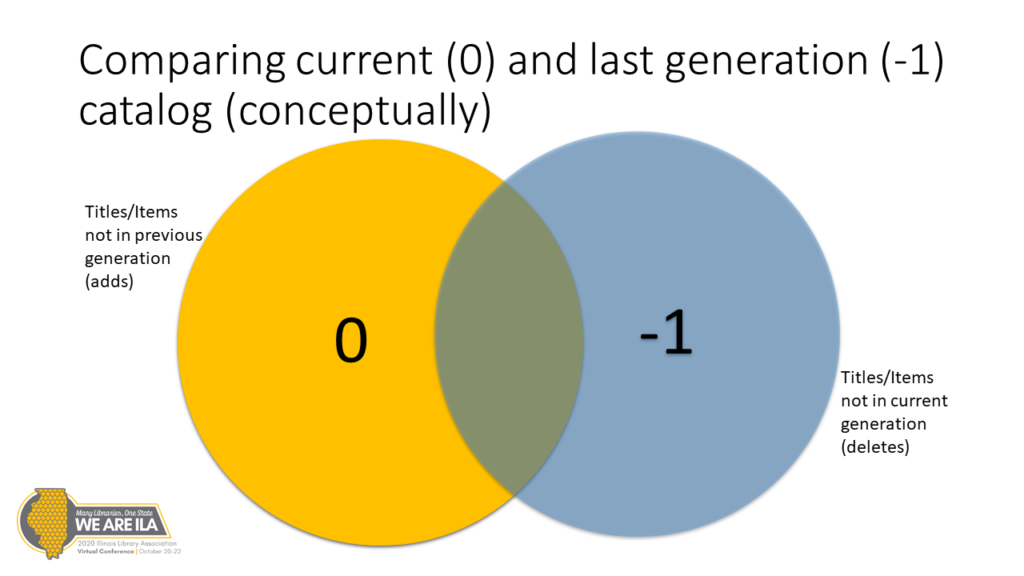
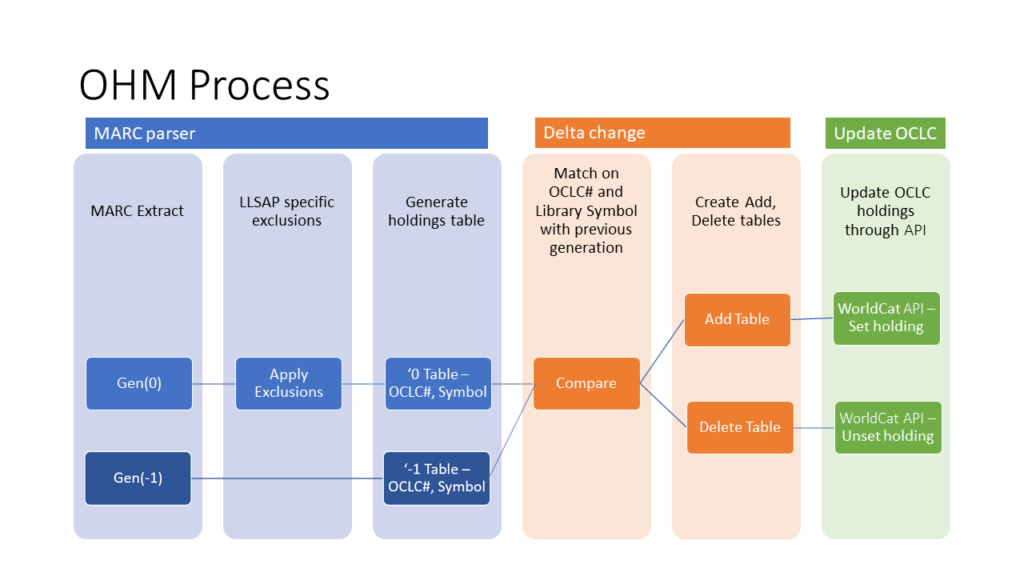
    OCLC Holdings Manager is a rule-based utility that analyzes MARC21 extracts and determines changes between datasets. This comparison is then used to set and unset WorldCat holdings using the OCLC WorldCat Metadata API. OHM was designed to be consortia ready, but should work just fine for standalone libraries as well.

    (See Github readme.md)
    Figure 1: OHM as a concept comparing two datasets

    Why are setting holdings in WorldCat important?

    WorldCat is the largest union catalog of library collections in the world. The ability to find and request items from reciprocating libraries within WorldCat is an amazing feat of library cooperation and leadership. Library users can search for any material eligible for lending and makes nationwide resource sharing possible. Having an accurate inventory of the library’s collection and the WorldCat system sets up efficiencies in WorldShare ILL and real-time availability (something else SWAN has accomplished).

    Some library consortium rely on individual libraries within their group to maintain accurate WorldCat holdings for the library. For other library consortium, this task is part of a central service. In Illinois, the State Library lead the effort to have library catalogs use OCLC as the sole bibliographic utility and to fund at the state level the effort to capture the library collections at a given moment in time (roughly monthly) and have a vendor update WorldCat through an automated process. This allows Illinois to have a statewide catalog representing the collections of three thousand libraries.

    Note: Much of the background on the importance of OCLC WorldCat holdings can be found in a committee working group report, which outlines the importance of this work.

    How did OHM come about?

    For 20 years in Illinois the centralized process for updating one thousand consortium member collections was performed by The MARC of Quality using a proprietary utility named OSMOSIS.

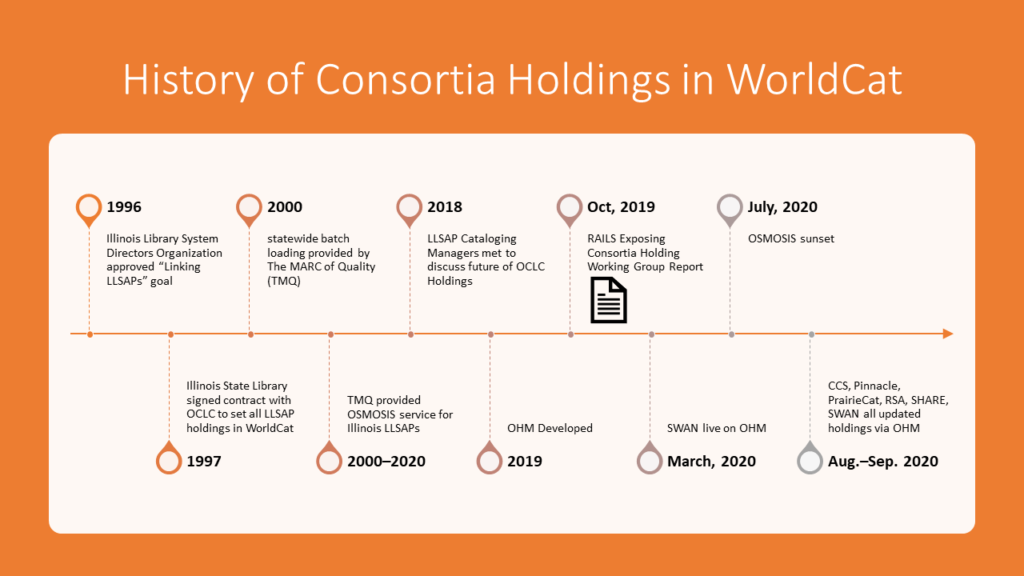
    The origin of OHM was to develop a replacement of the use of the OSMOSIS service. The MARC of Quality had a contract with the Illinois State Library funded annually (at $26,100 in 2019) for 8 runs of the OSMOSIS service across the year for 3 Illinois library consortia, PrairieCat, RSA, and SWAN. In 2018, The MARC of Quality announced that the service would no longer be supported, setting a two year sunset. This presented the library consortia with an opportunity to rethink the method of mass updating OCLC WorldCat holdings.

    Figure 2: a timeline of Illinois library activity related to WorldCat

    The process of creating what would become OHM started with Illinois consortium partners discussing what a new service would look like, and the opportunities for improving what had been a valuable 3rd party service. A typical month processing would set and unset WorldCat holdings for approximately 110,000 record adds and 165,000 record deletes. There is considerable churn within the six Illinois library consortia adding new titles and removing records no longer needed, so bulk updates to WorldCat required starting conversations with OCLC on the use of its set of Metadata APIs to accomplish this task.

    Figure 3: the acronym LLSAP in Illinois is “local library system automation program” which dates back to the 1970s as an official way to describe a library resource sharing consortium

    What OHM can do

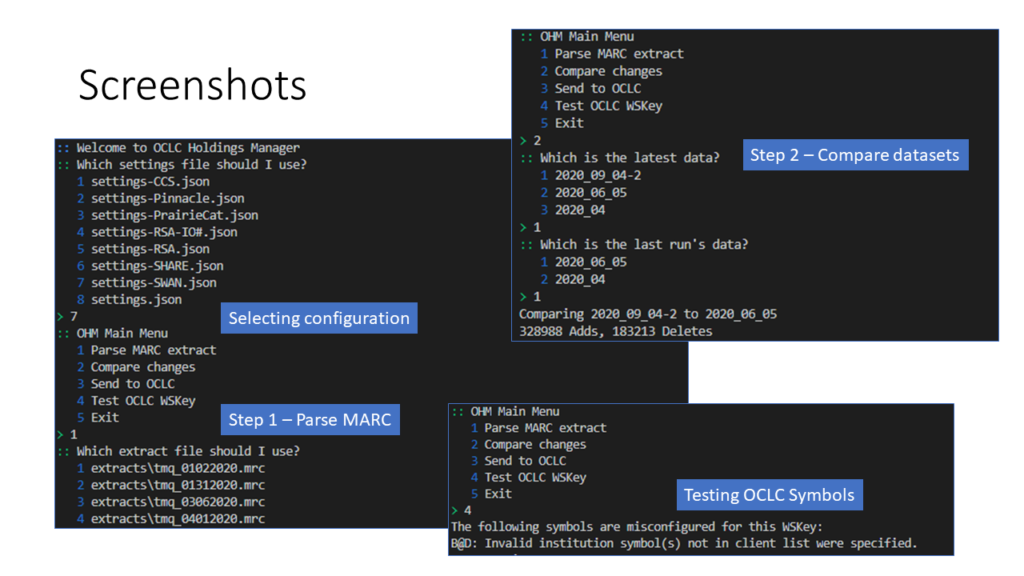
    For library consortia managing the WorldCat holdings of their libraries, OHM is a solution that can run with minimal requirements. The system utilizes a list of exported from the integrated library system, which is then uploaded into OHM. The system will compare that list to what had been uploaded prior, and from there it determines how it will perform adds and deletes within WorldCat for those member libraries.

    OHM requires a local installation on a system supporting Python, which is configured by an administrator as specified on the project Github. SWAN is utilizing a Linux server in its cloud environment for OHM, but it is flexible in how an administrator of OHM decides what operating system should run OHM.

    Figure 4: command line examples of OHM steps
    Figure 5: OHM process diagram

    In addition to monthly holdings update, OHM has been used to facilitate a WorldCat reclamation when libraries are added to a consortium. Through use of OCLC Collection Manager, a snapshot of holdings for the library can be retrieved, feeding into OHM as delete holdings. With the next full run of the consortium catalog, the new library’s holdings are then set/updated.

    OHM in full production

    The software platform jointly developed among the six Illinois library resource sharing consortia is now in full production with monthly updates of OCLC holdings reflecting the most accurate representation of the library collections in WorldCat Discovery to-date. Six Illinois consortia holdings in WorldCat are updated monthly using a software platform. The monthly processing is coordinated by a group of SWAN employees, ensuring back-up and redundancy in support.

    Acknowledgements

    The creation of OHM is the result of individuals at Computer Cooperative Services, Pinnacle Library Cooperative, PrairieCat, Resource Sharing Alliance, SHARE, and SWAN coming together over the course of a year to discuss and design the OCLC Holdings Manager. The success of this project would not have been possible without the involvement of Bruce Crocco, Cynthia Wilson, and Don Litner at OCLC.

    This overview uses visuals from the SWAN presentation of OHM at the Illinois Library Association 2020 virtual conference. The presentation by Dawne Tortorella, Rudy Host, and Scott Brandwein was not recorded or archived by the Illinois Library Association. These three individuals were instrumental in creating OHM.

  • The Great Recession Impact on Illinois Public Libraries

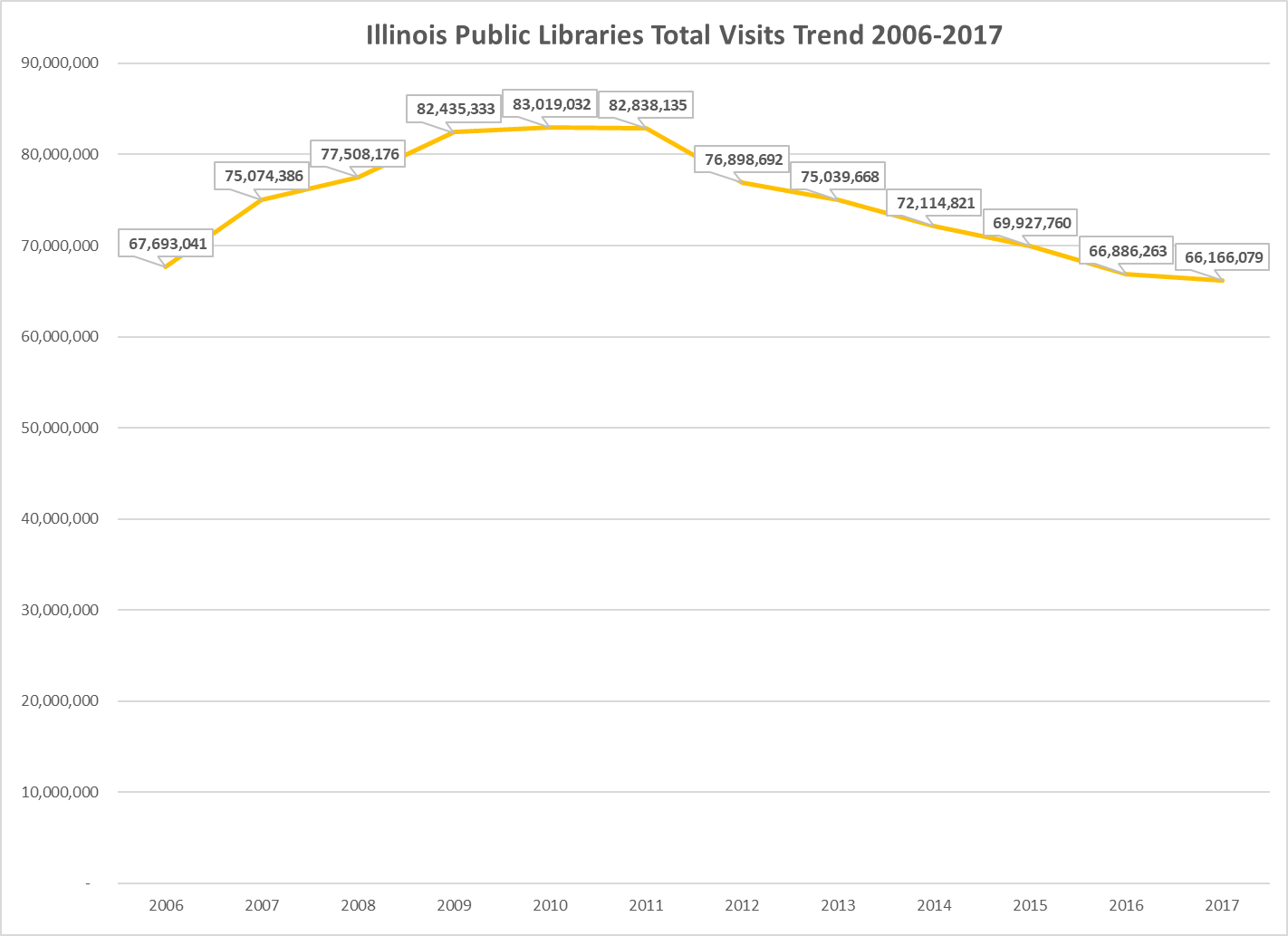
    US public library usage during the 12 year window of the Great Recession show a dramatic increase between the 2009-2011 years. The Illinois public library usage in the areas of visits, circulation, and program attendance also show evidence of the Great Recession. This impact is primarily seen in the 2009-2011 years. The totals for the Illinois public library metrics for library visits, circulation, and program attendance are below. However, a closer look at data shows that not all Illinois public libraries appear to have been impacted equally by the Great Recession.

    IMLS data tracking public library visits in Illinois

    Illinois public library visits peaked in 2010, and for the seven years following the visits have fallen, and by 2017 are below the 2006 library visits total.

    IMLS data tracking public library annual circulation in Illinois

    Illinois public library circulation totals also show 2010 as the highest year for this metric, as it was for library visits in 2010.

    IMLS data tracking public library program attendance totals in Illinois

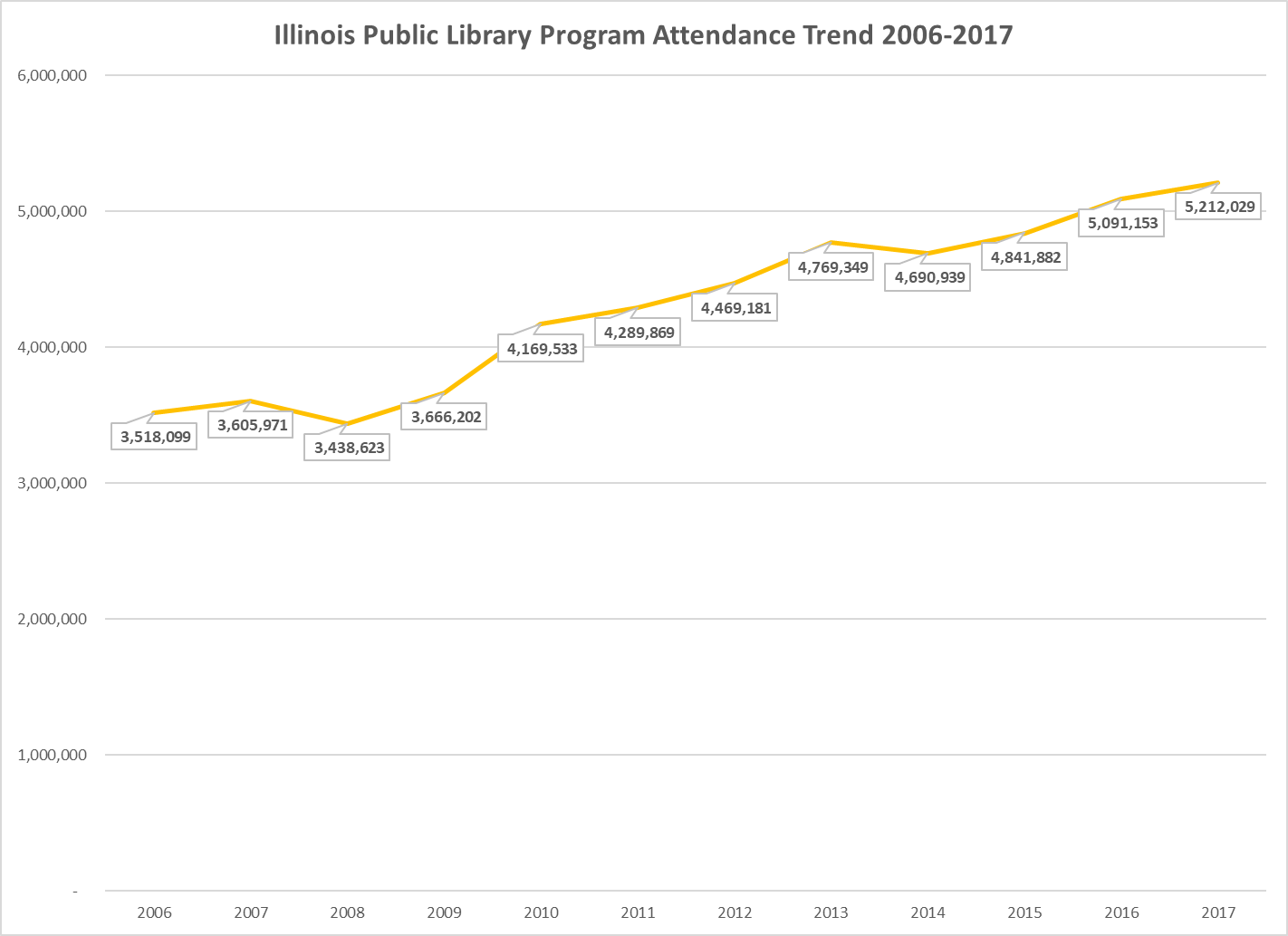
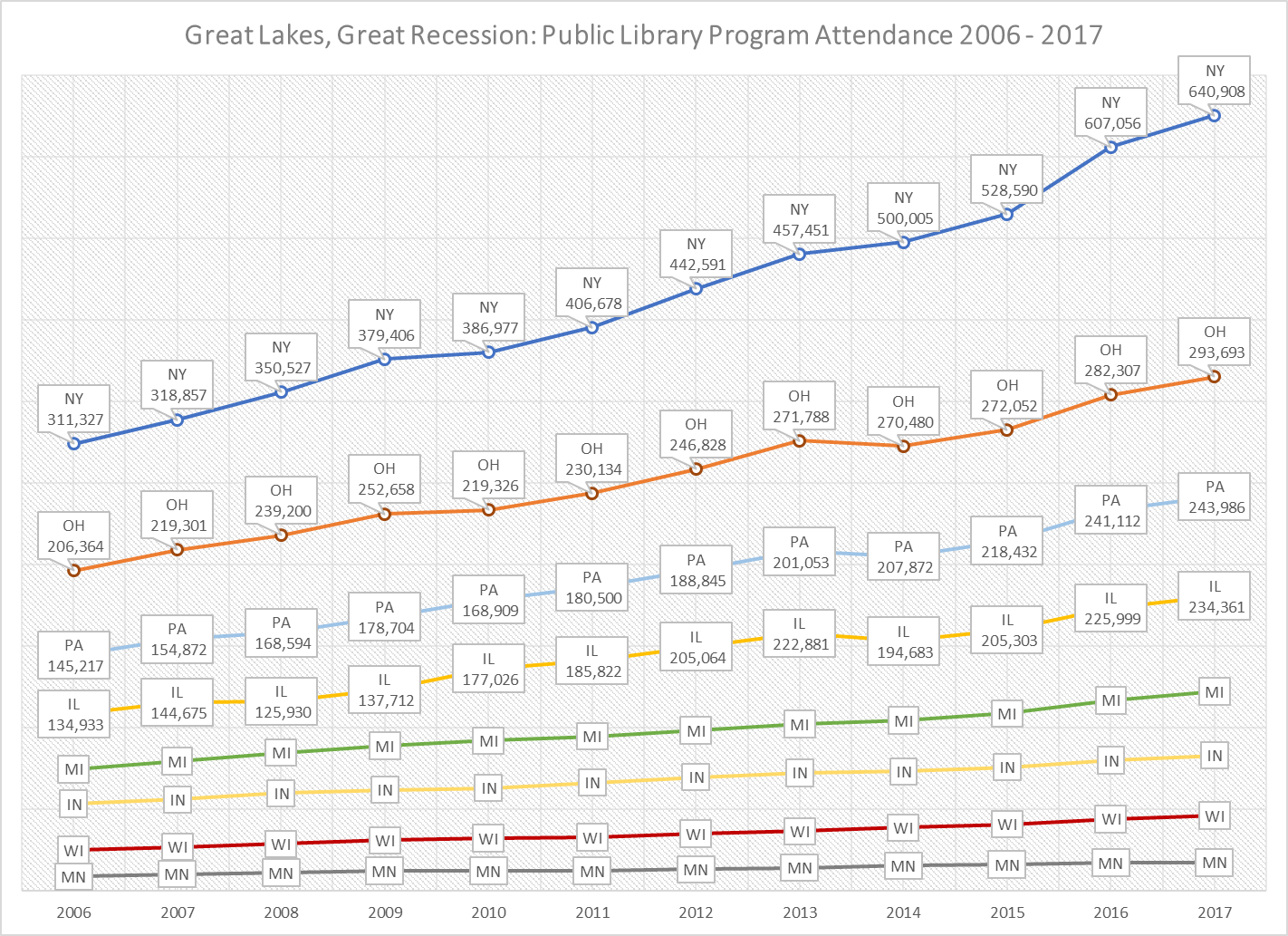
    Library program attendance has largely defied the Great Recession impact, showing a modest increase over the 2008-2017 period. While this metric is a sign of success, it is worth pointing out that program attendance represents 0.4% of the total public library visits.

    Chicago Public Library visits during the 12 years of 2006-2017 reflect the national trend of library visits peaking in 2009 and then falling each year after the Great Recession.

    For the libraries serving large populations over 100,000 other than Chicago Public Library, the visits for the 2006-2017 period reflect the Great Recession trends, but not as clearly. The use of a graph also highlights some data anomalies, such as the Naperville Public Library visits in 2016 (see the top blue line which falls in 2016). Schaumburg Public Library also has a steep decline for the 2017 year, but this is the first year since 2008 in which visits data is not rounded to a broad number, which may reflect some change in how visits are recorded at the library.

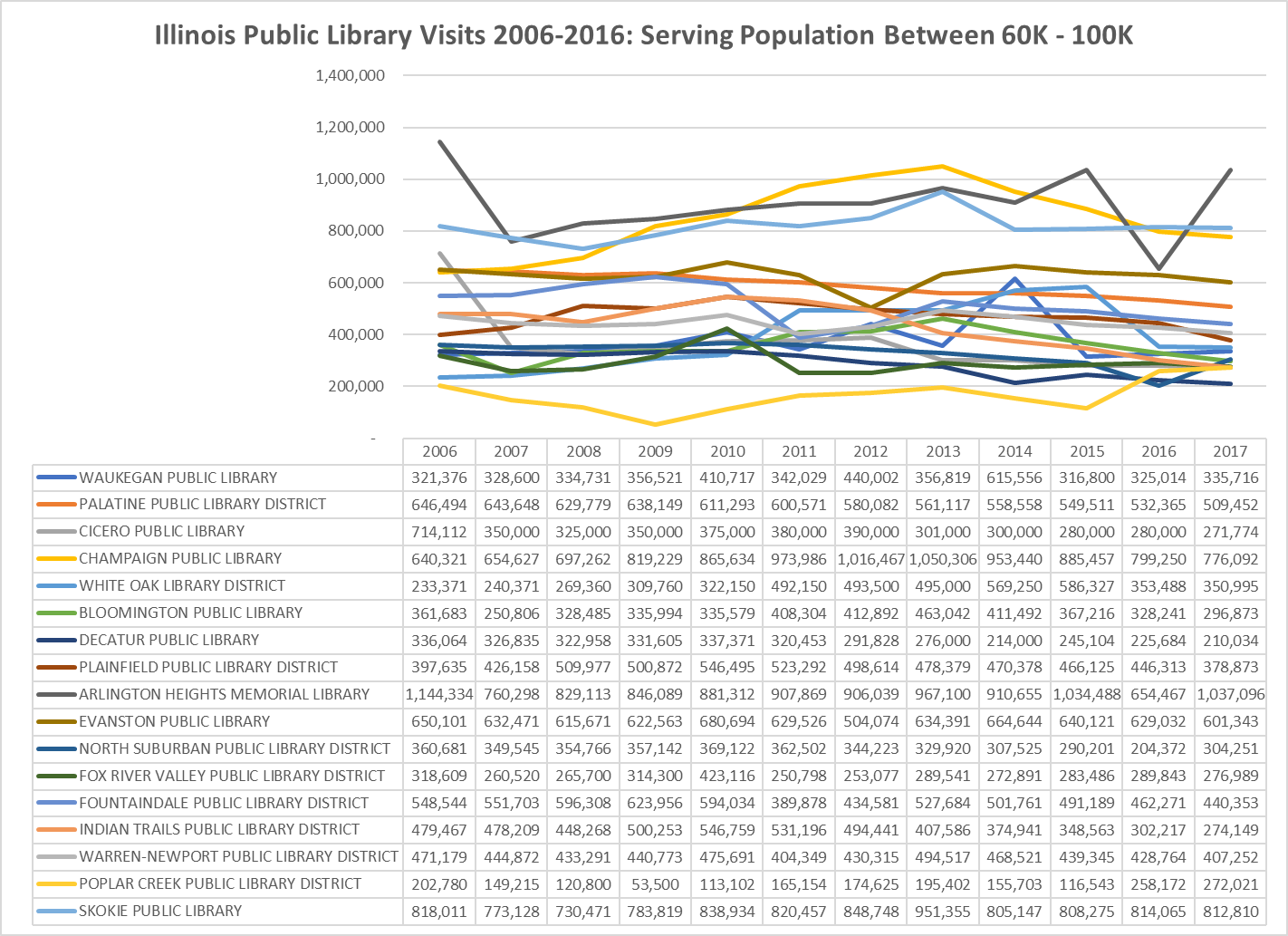
    For the libraries serving a population between 60,000 and 100,000, the visits do not reflect the Great Recession trends overall. There again are some indications of data anomalies, such as the Arlington Heights 2016 library visits reported to IPLAR, but overall the trend for this group of libraries shows visits are holding steady compared to the other public libraries within this population group.

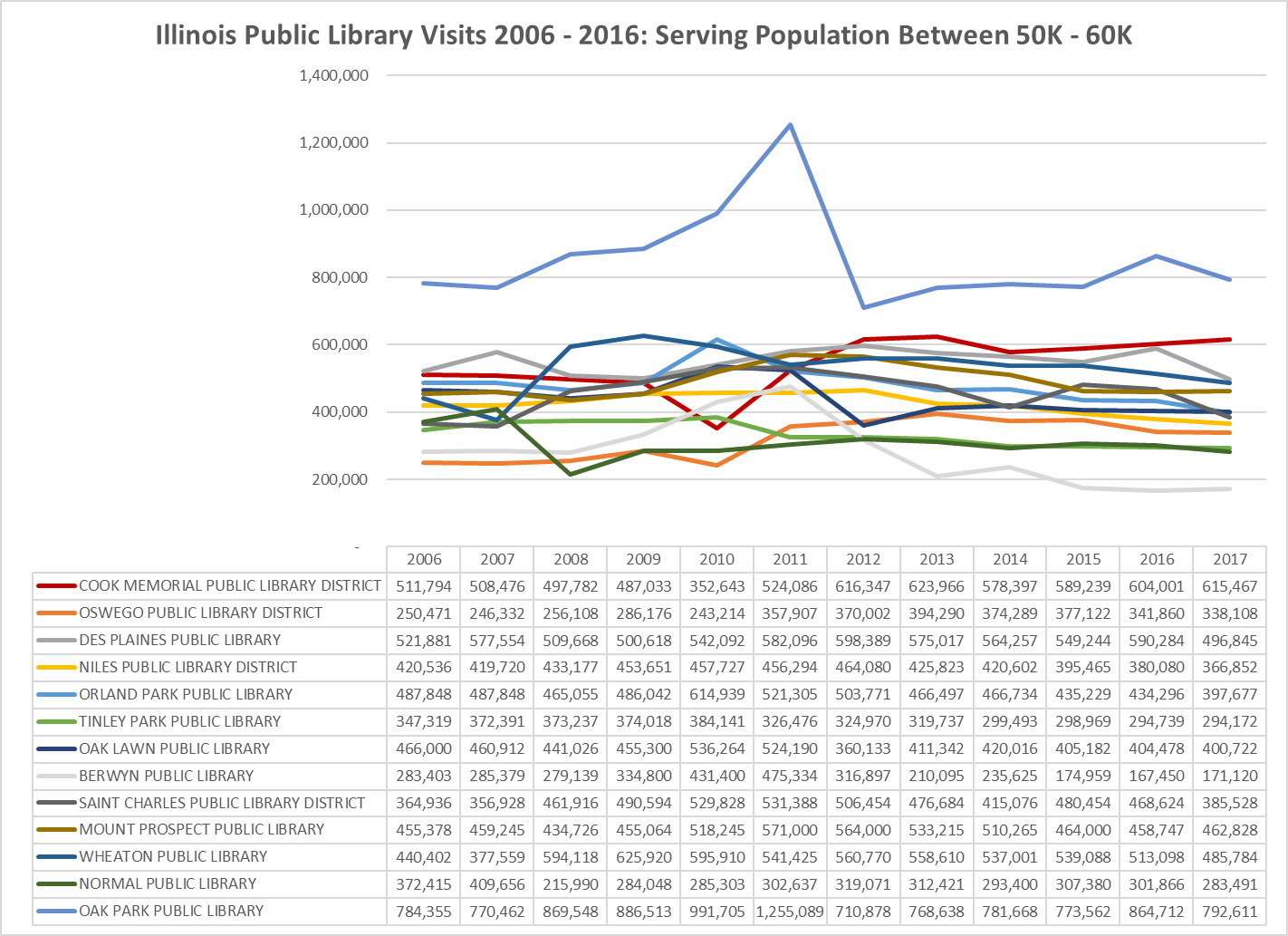
    For the libraries serving a population between 50,000 and 60,000 there is a strong indication of the Great Recession in the 2011 year for the Oak Park Public Library. The visits for Oak Park Public Library are strong for this population group—showing this library is consistently is “punching above its weight.”

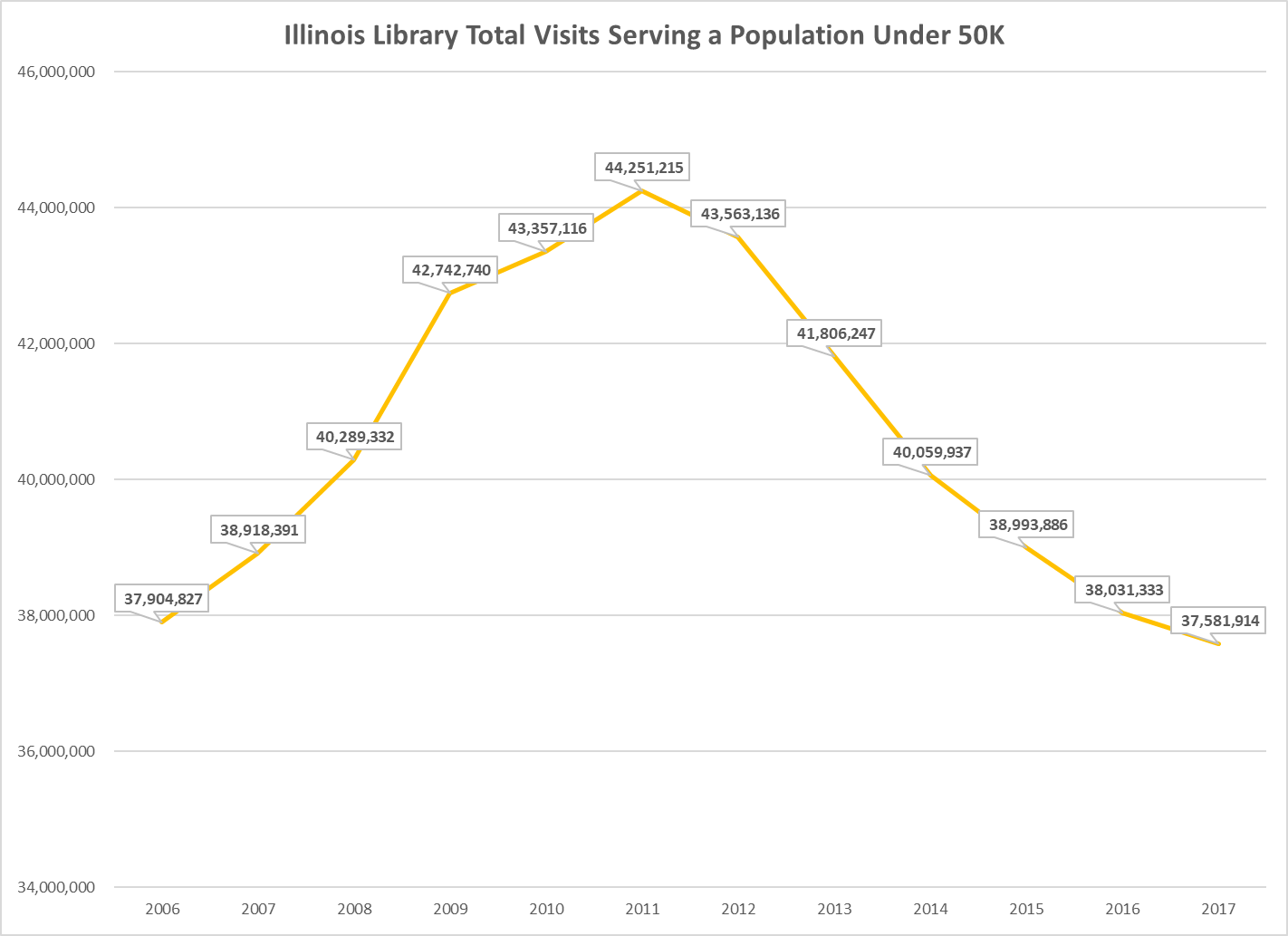
    There are 583 Illinois public libraries under the 50,000-population threshold. Their combined library visits reflect a 2011 peak in library visits, two years after the US public library national trend.

    In conclusion, the IMLS data for Illinois during the 12-year range of 2006-2017 shows the Great Recession impact for the Chicago Public Library, Oak Park Public Library, and those 583 combined libraries under the 50,000-service population. Those libraries above 50,000 population served (excluding the Chicago Public Library) do not show a Great Recession impact as dramatically. 

  • The Great Recession Impact on US Public Libraries

    With talk of a potential new economic recession, it seems appropriate to assess how the last recession—the Great Recession—impacted public libraries in the US. The Institute for Museum and Library Services (IMLS) makes its public library survey data available online, and if we examine this data on a state by state basis, or as a whole for the Unites States, we can see the dramatic impact the 2007-2009 Great Recession had on public libraries..

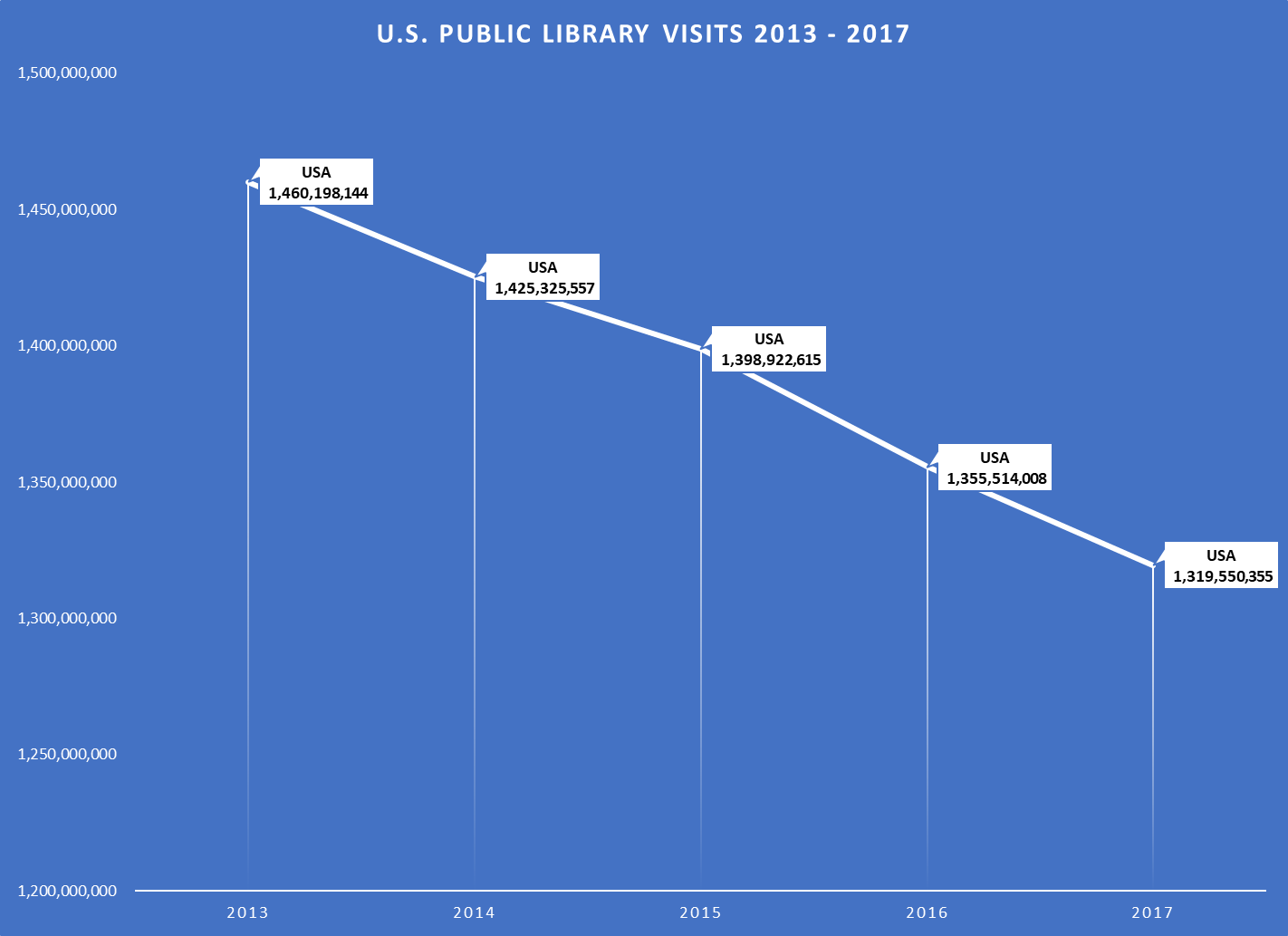
    It is important to understand the scope and size of the impact of the Great Recession. If we only look at data for the past 5 years, we would see an alarming downward trend. (Please note: IMLS public library survey data is only available through 2017.)

    If your library leadership saw this sort of trendline, alarm bells would be sounding about the precipitous decline in library visits. However, a much wider view of the data is needed in order to see what is truly happening.

    What we are seeing is that the impact of the Great Recession still reverberates throughout US public libraries nine years after the fact. US Public library usage peaked in 2009, the year the Great Recession technically ended. Overall, US public library visits are now below the 2006 usage levels. 

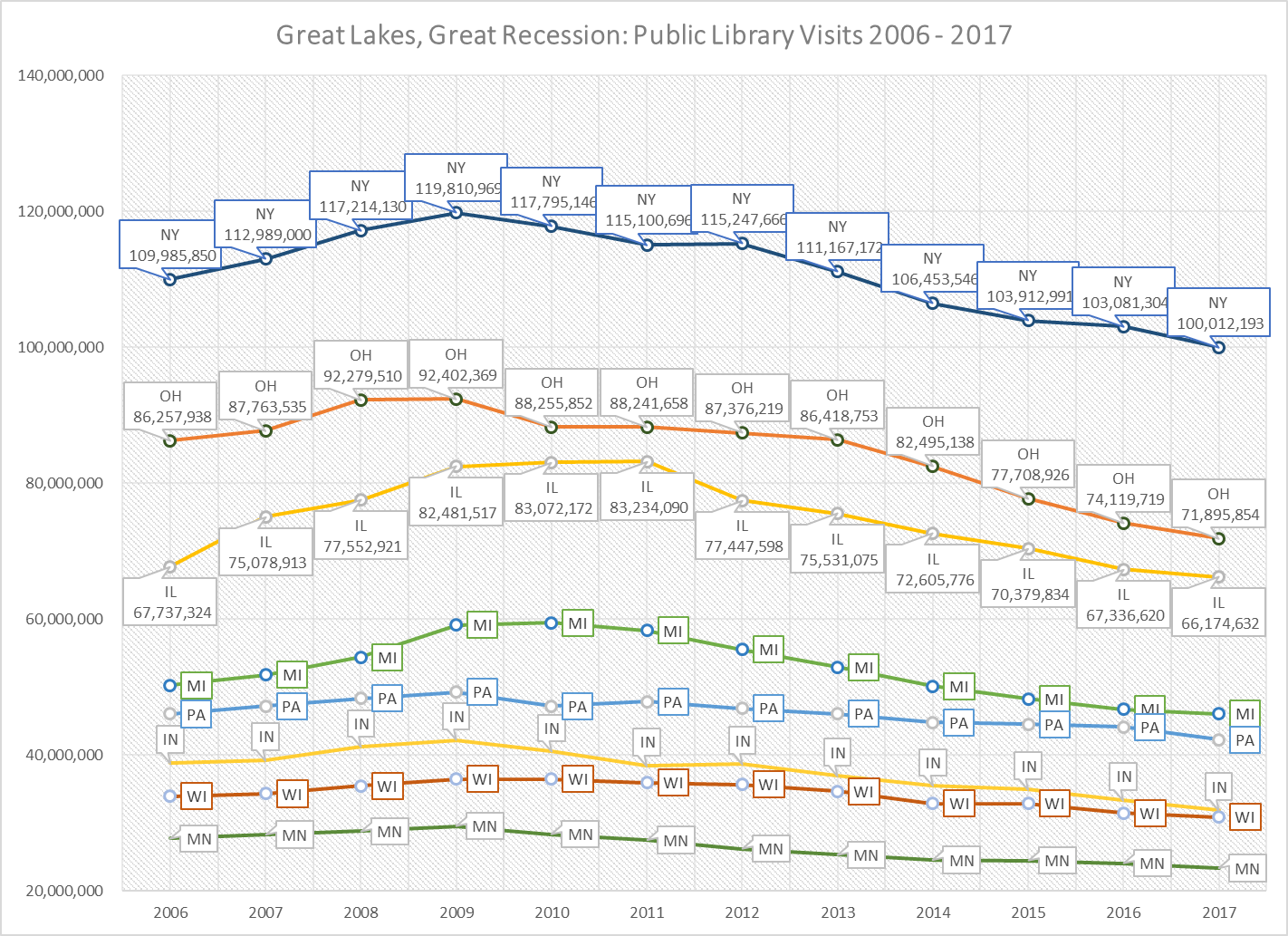
    Using the 8 states in the US Great Lakes region as a comparison, we can see that Illinois public libraries experienced a steep rise in library visits, peaking in 2011 at 83,234,090. Since that year, Illinois has seen public library visits falling steadily.

    Illinois public library circulation metrics also reflect this rise and fall, peaking in 2010 at 121,828,806 and falling 12% over the next 7 years. Illinois circulation numbers are holding steady for 2016-2017.

    There are some bright spots in the data. Public library program attendance has been steadily rising, showing no evidence in the public library survey data of the falling when compared with circulation and library visit data. It is worth noting, however, Illinois public library program attendance represents only 0.4% of the total Illinois public library visits.

    What can library leadership and staff do with this data?

    • If library trustees are overly focused on the year to year circulation and library visit counts, they should be made aware of the overall impact of the 2009 Great Recession. Context is key!
    • Regions matter—if your public library is seeing these downward trends, chances are that your neighboring libraries in the region are seeing the same trends.

    The Illinois Public Library Annual Survey (IPLAR) data is provided to the IMLS, so your hard work each year helps with research and analysis. You can look forward to my next post on how Illinois public libraries individually are trending in these same metrics.